New Horizons
 Project Management Academy
 Six Sigma Online
 TCM Security
 TRACOM
 Velopi
 Watermark Learning
 Login
Login



Key Takeaways
- Usage Measures Activity: High adoption numbers don’t mean the workflows adapted
- Build Real Judgment: Prompting skill alone doesn’t teach task selection, delegation, or risk
- Bottlenecks Need Owners: A faster task exposes bottlenecks with no clear owner
- Managers Make It Stick: Authorization only works when managers reinforce it daily
- Move Three Levers Together: Ownership, management, and judgment only work as one system
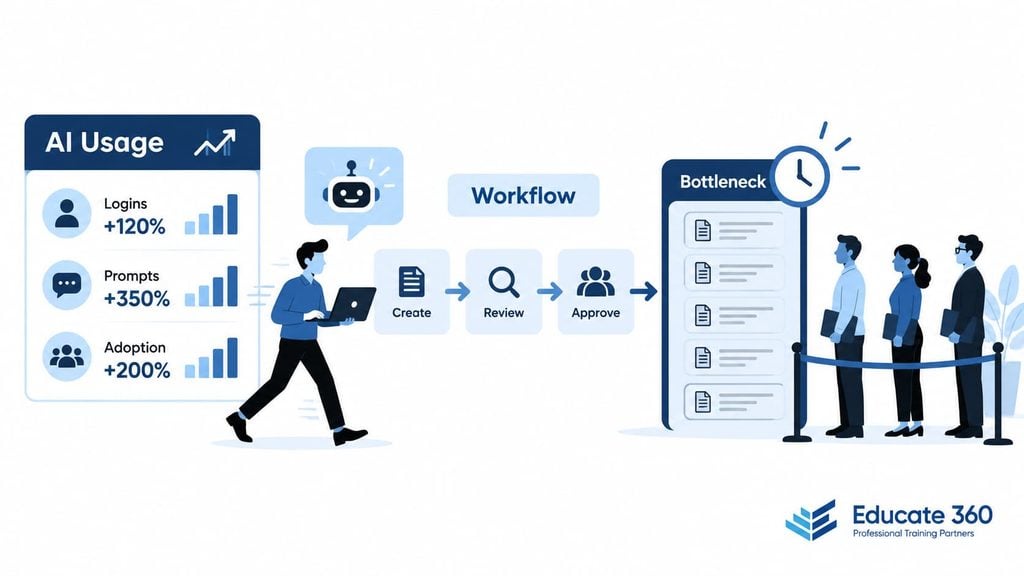
Picture an employee whose task used to take two hours. With AI now doing the heavy lifting, it takes twenty minutes.
This speed never made it past the employee’s desk. Their completed work still sits in a queue for four days, waiting on the same approval step that existed before AI entered the workflow. No one was responsible for changing that step, so no one did.
The same gap shows up across other departments too. AI adoption numbers climb, login counts look healthy, and prompting activity is up. Still, the workflow speedup it was supposed to deliver is uneven, if it shows up at all.
Employees learned to operate the tool, but many organizations overlooked equipping their leaders to change the workflow around it. This is the missing leadership piece: someone with the authority to look at a process, question why a step still exists, and change it if needed.
To close this gap, three things must move together: workflow ownership, manager reinforcement, and role-specific judgment. Skip one, and the other two fall short. From there, the path forward moves through ownership, management, and judgment, one workflow at a time, before trying to scale. None of this work shows up on a dashboard, which can’t answer the question that matters most: what the numbers prove.
Workflow Transformation Means More Than AI Usage
Usage numbers only prove that people used a tool. A team can have near-universal AI adoption, every employee logging in daily, every workflow touched by a prompt, and still do the work exactly the way it did a year ago.
This gap survives because usage numbers are easy to measure, so they stand in for progress regardless of whether they should. A dashboard that shows adoption climbing looks like a win, and leadership treats it as such, long before anyone checks whether the work coming out the other side looks different.
What those numbers track is narrower than it looks:
- Login counts: track whether someone opened the tool
- Prompting activity: tracks how often someone typed a request
- Adoption percentages: track how many people crossed a minimum usage threshold
None of these numbers track what happens to the work once it leaves that person’s hands. Organizations using AI in at least one business function climbed to 88% in 2025, up from 78% the year before, according to McKinsey’s State of AI research.
Yet 56% of CEOs report neither increased revenue nor reduced costs from their AI investments over the past 12 months, according to PwC’s 2026 Global CEO Survey. Usage went up steadily. Financial proof that anything changed didn’t follow at the same pace.
A department can hit 100% adoption and still ship the same work through the same approval steps at the same pace as before.
Nobody has cleared the path for the workflow itself to change. The employee from the opening example felt that gap directly, faster work, same wait. Closing it means tracking a different signal: whether people closest to the work have the standing to change how it moves, beyond having a login to use a new tool.
Build Judgment Beyond Tool Skills
Having the standing to change how work moves is only half of it. Someone still must know which changes are worth making. Role-specific judgment fills the gap, not prompting mechanics. Knowing how to phrase a request well gets an employee a better output, but it doesn’t tell them whether that output should go to a client as-is, or whether the task should have gone to AI at all.
It’s a different skill entirely, one that separates someone who gets good outputs from someone who knows what to do with them.
This skill covers a different set of decisions:
- Task selection: deciding which work AI should touch at all
- Delegation: knowing who else needs to see the output before it moves forward
- Evaluation: checking whether the output holds up
- Risk recognition: spotting when a wrong answer costs something
- Communication: framing the result so the next person can act on it
A prompting tutorial can’t teach any of this, because none of it is about the tool. It’s about the judgment calls that happen before and after the prompt.
There’s a quick and informal way to discover if a team lacks shared judgment. Ask three to five people on a team the same question about a task they handle regularly and see how much their answers diverge. Different answers mean nobody’s agreed on what “good” looks like before using AI.
Divergence here is a leadership question before it’s a training question. Someone must define which decisions stay fully human, what quality means, and where the escalation point sits. Undefined judgment is exactly what left one employee’s fast work waiting on someone else’s call. A team with clear definitions doesn’t need every decision escalated; they know which calls are theirs to make.
An Exposed Bottleneck Still Needs an Owner
Inconsistency isn’t unique to judgment. It happens anywhere shared definitions are missing. Ownership is no exception and nowhere is that clearer than in the employee whose task dropped from two hours to twenty minutes.
Speeding up the task didn’t create the delay in approval. An already-slow approval step did, and a faster task was all it took to expose it.
Exposing a bottleneck doesn’t repair it. Fixing it requires someone with the standing to review the approval step, question why it exists, and change it. This is where workflows can stall without a clear owner in place: the bottleneck remains with nobody to fix it.
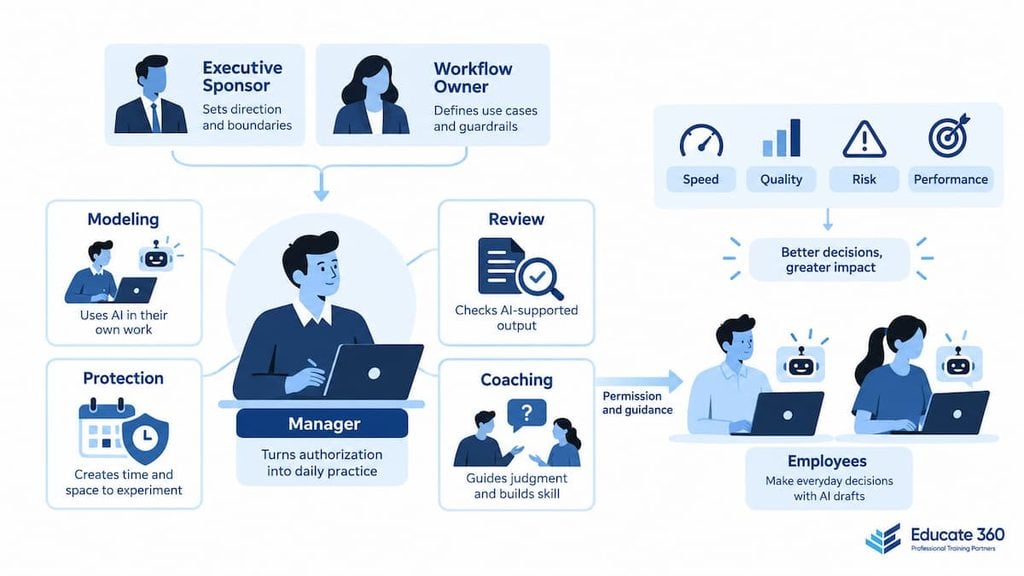
Clarity on four distinct roles closes the gap:
- Executive sponsor: supplies the mandate to act and resolves conflict when the fix affects multiple departments
- Workflow owner: leads the actual review, answers for the outcome, and recommends or implements the authorized change
- People manager: translates the change into what their team is expected to do differently day to day
- Employee: applies AI within the new boundaries and reports where the workflow still causes friction
Skip any one of these roles, and the bottleneck stays exposed but unowned, exactly where it was before the task got faster.
This structure raises a real question too: who’s accountable when AI-assisted work turns out wrong? Without an answer, delays don’t shrink, and the workflow owner’s review goes nowhere. Once those roles are filled, delays become a problem someone is actively solving.
Equip Managers to Turn Authorization Into Daily Practice
The roles above a people manager set the boundaries, but none of them make daily calls. A workflow owner authorizes the change; an executive sponsor grants the mandate. The employee whose task now takes twenty minutes still must decide, in the moment, whether to trust an AI-generated draft, and the people manager is accountable for the quality of that call.
How employees handle the moment often depends on something the people manager controls: permission. Most employees already sense when a shortcut is safe to take. What they’re usually missing isn’t awareness, but the permission to act on it.
With higher-level boundaries set, a manager’s job narrows to four responsibilities:
- Modeling: using AI themselves rather than delegating it entirely to their team
- Protection: guarding time for experimentation instead of treating every hour as already spoken for
- Review: catching problems in AI-supported output before they reach the next person
- Coaching: asking why an employee made a call, not checking policy adherence alone
Coaching judgment matters because the daily trade-offs managers resolve rarely have a clean answer. Speed, quality, risk, and performance expectations pull against each other constantly, and a manager must make a call inside whatever boundaries the workflow owner has set.
A manager who only checks compliance catches policy violations. One who coaches judgment builds a team that makes better calls over time, but that skill alone isn’t the whole system.
Make the Three Levers Move as One System
Workflow ownership, manager reinforcement, and role-specific judgment don’t work as separate initiatives. Each one solves for a different part of the same gap, and dropping any one of them leaves the other two working against a wall they can’t move on their own.
One part moving faster was never the goal. The task takes twenty minutes now; the goal is a workflow that moves in twenty minutes too, not one that takes four days once the task is done.
Real-work practice loops and peer mentoring show what this integration looks like in practice. A workflow owner can authorize both. Neither lasts without a manager actively reinforcing them daily, which is a sign that reinforcement isn’t a separate initiative. It’s what manager reinforcement looks like.
The other two levers hit a structural problem first: the organization isn’t built to move all three together. Different departments fund and run different pieces, tool training, leadership development, process improvement, governance, each optimizing its own slice. The employee experiences all four at once, inside one workflow.
The seams between them go unwatched, which is where delays sit.
Managing those seams also means changing what the organization measures. Tracking must move up a hierarchy:
- Adoption indicators: who’s using AI, and how often
- Behavior changes: what people are doing differently in their day-to-day work
- Workflow outcomes: whether tasks move through the organization faster, with fewer handoffs, or with different approval requirements
- Business results: whether any of that shows up in cost, speed to market, or quality that customers or stakeholders notice
Adoption indicators are the easiest to collect and the least connected to whether anything changed. Business results, at the far end of the hierarchy, are harder to attribute cleanly to any one initiative. Still, they’re the only tier that shows whether the three levers moved together under someone’s accountability.
Ownership Is the Finish Line
Most organizations evaluate their AI adoption by asking whether employees are using the tool. It’s a reasonable question, but it’s the wrong one. Usage confirms activity. Accountability confirms the work changed. The employee whose task dropped from two hours to twenty minutes is still waiting to find out which one their organization measures.
The better question is whether the organization built the ownership for that change, an executive sponsor to authorize it, a workflow owner to lead it, a manager to reinforce it daily, and employees equipped to exercise judgment. Skip any of those, and widespread AI adoption produces the same delays, only faster on one end. None of these levers work alone, and the same goes for employees: most already know what needs to change, but knowing isn’t permission to act.
Is your organization authorizing that change, or training people to use a tool and calling it transformation? The hardest workflow to fix is rarely the one with the most friction. It’s the one nobody has clear authority over.
At Educate 360, we bring together training expertise across leadership, communication, and role-based skill development, starting with alignment on where AI fits, moving into tool-specific coaching by role, and ending in hands-on practice on real work, not a one-time walkthrough of the interface.
We partner with mid-to-large organizations to build a training package that equips leaders to establish and carry out authority. If you’re ready to capitalize on rising usage numbers with workflows that move faster, let’s discuss how we can make that your reality.
For a long time, organizations asked whether employees would trust AI enough to use it. The ones pulling ahead are asking a different question: whether the organization trusts employees enough to redesign the work around it.