New Horizons
 Project Management Academy
 Six Sigma Online
 TCM Security
 TRACOM
 Velopi
 Watermark Learning
 Login
Login



Leadership training works. That part isn’t the problem. A well-designed session can shift how a leader sees themselves, sharpen their awareness of how they communicate, and send them back to their team with a genuine intention to lead differently. That energy is real, and it matters. The problem is what happens after the room clears.
Most organizations measure training success at the event itself, tracking attendance rates, survey scores, and facilitator feedback. What those metrics miss is the only question that matters: did anything change back on the job?
At XentinelWave, like most mid-to-large organizations, leaders leave development programs with strong intent. Whether that intent translates into consistent behavior depends almost entirely on what the organization builds around the training, not the training itself.
Understanding which behaviors take root, which ones stall, and what determines the difference is where the real value of leadership development lives and where most organizations have the most room to grow. It’s worth sitting with because many organizations don’t stop to ask it.
What Training Changes First
Leadership training creates real shifts, and it’s worth naming them before discussing where things break down. A well-designed program gives leaders a clearer picture of how they show up, a sharper sense of where their communication falls short, and a genuine intention to lead differently.
Those aren’t small things. They’re the starting point for everything that follows, but they aren’t sustained behavior change. Awareness and intent are early-stage outcomes. They’re meaningful, but they need the right conditions to last.
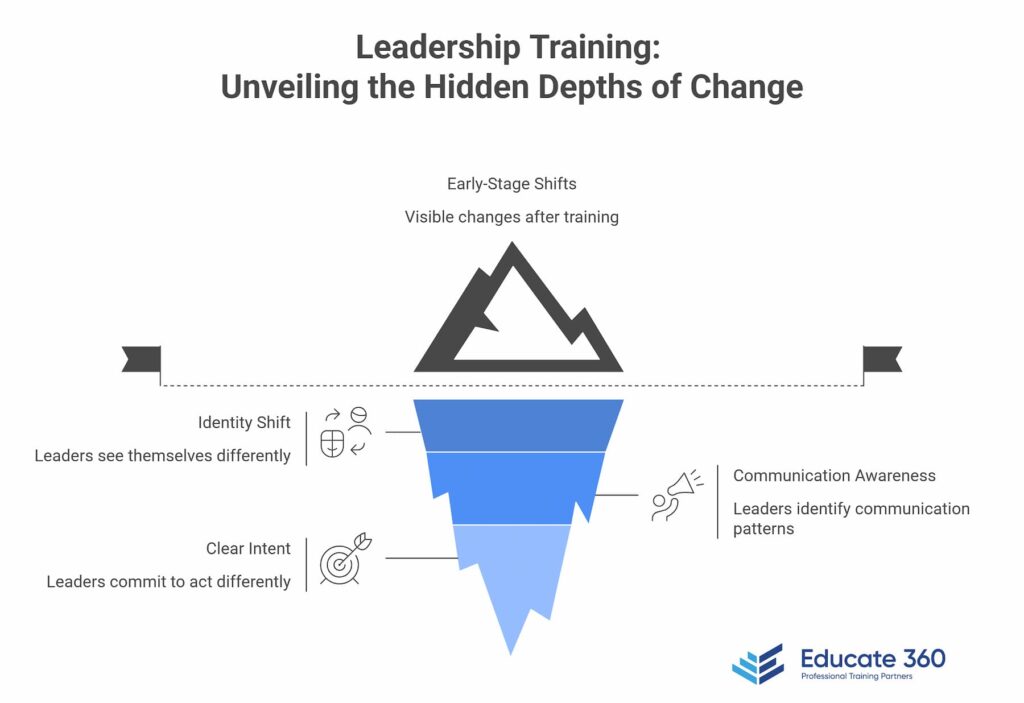
Strong training programs produce three consistent early-stage shifts among participants.
What Leaders Gain from Training
- Identity shift: Leaders see themselves differently and recognize gaps in how they lead
- Communication awareness: Leaders identify patterns in how they communicate that aren’t serving them
- Clear intent: Leaders leave with a genuine commitment to act differently on the job
These shifts matter, but they’re the beginning of the process, not the outcome. Without the right conditions after the training event, they fade faster than most organizations expect.
Success shouldn’t be measured at the end of a training session. It should be measured in what happens after. Understanding why some behaviors take hold while others don’t is more predictable than many organizations realize, and it starts with recognizing that not all leadership behaviors are the same.
The Two Types of Leadership Behaviors
Not all leadership behaviors change in the same way after training. Most fall into one of two categories, and understanding the difference is what separates organizations that see lasting results from those that keep wondering why their training investments aren’t paying off.
The difference between the two isn’t about how hard a behavior is to learn. It’s about what the behavior depends on once the training is over. Organizations shape that dependency far more than leaders do.
Two categories shape how leadership behaviors respond to training, and the difference between them is what determines their lasting impact.
Two Categories, One Critical Difference
- Fast-Adoption Behaviors: Applied immediately, no organizational support required
- Supported-Adoption Behaviors: Require reinforcement, environment alignment, and repeated practice
A fast-adoption behavior lives within the leader’s control. A supported-adoption behavior must hold up under organizational pressure, competing priorities, and cultural norms that may or may not support it.
Recognizing which category a behavior falls into changes how training should be designed, reinforced, and measured. The clearest place to start is with the behaviors that do show up right away, because understanding what makes them work reveals a lot about what the harder ones are missing.
The Behaviors That Take Root Right Away
Some leadership behaviors shift almost immediately after training, and the pattern is consistent across industries and organizational types. These aren’t the most complex skills leaders develop. Still, they show up in everyday interactions and don’t require anyone else’s buy-in to practice.
Four behaviors consistently emerge as fast-adoption behaviors across leadership development programs.
What Leaders Apply Right Away
- Active listening and presence: Used in every interaction, with immediate and visible feedback
- Asking better questions: Simple to apply, easy to repeat, and low-risk to practice
- Communication style awareness: Applied immediately once leaders understand how their style affects others
- Meeting structure and facilitation: Visible, frequent, and adjustable in real time
These behaviors share three characteristics that explain why they take hold faster than others. They’re immediately usable, high-frequency, and require no permissions, system changes, or cultural shifts to practice.
Leaders improve quickly in these areas because they control when and how they use them. Every conversation becomes a practice opportunity. The behaviors that don’t follow that pattern are a different story, and understanding what makes them harder is where the real work begins.
The Behaviors That Need More From You
Some leadership behaviors don’t follow the same pattern as the ones covered earlier. They’re not harder because they’re more complex to understand. They’re harder because they must hold up under pressure, ambiguity, and organizational conditions that often work against them.
Four behaviors consistently emerge as supported-adoption behaviors across leadership development programs.
What Leaders Struggle to Sustain
- Giving direct, timely feedback: Requires psychological safety and cultural reinforcement
- Delegating effectively: Tied to trust, identity, and perceived risk
- Navigating difficult conversations: Requires confidence built through repeated practice
- Shifting to strategic thinking: Competes directly with daily operational pressure
These behaviors share a common thread. Each one must survive conditions that fast-adoption behaviors never face. A leader can decide to ask better questions during any meeting. However, giving direct feedback to a struggling team member requires more than what training can replicate.
At XentinelWave, this was most visible around delegation. Leaders understood the concept and left training with a clear intent to apply it. Back on the job, competing priorities and deeply ingrained habits made consistent application far harder than expected.
The barrier to change isn’t knowledge. It’s the environment, and most training programs aren’t built to address that. The gap between what leaders learn and what they consistently do is where the real story unfolds.
The Behavior Change Gap: Why Training So Often Doesn’t Last
Between learning something new and consistently applying it, there’s a predictable point of breakdown. It doesn’t happen because leaders aren’t motivated or capable. It happens because the conditions that support behavior change are rarely built into how training is designed.
The gap shows up in a recognizable pattern. After completing training with real motivation to apply what they learned, leaders return to a full workload and find no structure in place to reinforce what they learned.
This issue played out at XentinelWave around direct feedback. A leader left training committed to addressing performance issues more directly. Still, without coaching or reinforcement in place, the first real opportunity passed. The knowledge was there. The behavior wasn’t.
Four conditions are most responsible for creating this gap in the first place.
Where the Breakdown Happens
- No post-training reinforcement: Skills fade without structured follow-up and accountability
- Disconnected from real work: Learning disconnected from actual role conditions doesn’t transfer
- Unsupportive environment: Cultural norms and management behavior can undermine new skills
- No personalized path forward: Leaders need clarity on what to practice next
Closing the gap isn’t about delivering better training content. It’s about building the right conditions around it. Knowing what those conditions are is what separates organizations that see lasting behavior change from those that keep investing in training without seeing it.
What It Takes to Make Change Last
Sustained behavior change doesn’t happen by accident. It happens when four specific conditions are present. Organizations that build these conditions into their development programs see results that go well beyond what any single training event can produce.
These conditions aren’t complicated, but they do require intentional design. Most organizations focus their energy on the quality of the training content itself and treat everything that comes after as secondary. That’s what opens the gap.
Four conditions determine whether behavior change takes hold or fades after the training event.
What Sustained Change Requires
- Contextual relevance: Learning connects directly to the leader’s real role and challenges
- In-role repetition: Skills practiced where they’re expected to show up
- Structured reinforcement: Coaching and accountability extend beyond the training event
- Communication foundation: Leaders understand how they operate and how to adapt
Each condition addresses a different layer of the behavior change problem. Together, they shift development from a one-time event into an ongoing process that gives new behaviors a real chance to hold.
When these conditions are present, behavior change becomes predictable rather than accidental. Reinforcement can be as straightforward as coaching check-ins, peer accountability pairings, or manager-led follow-up conversations. Organizations that build these structures stop wondering why training isn’t working.
Why Some Organizations Get This Right, and Others Don’t
Most organizations want their leadership development investments to produce lasting results. The ones that consistently achieve that aren’t necessarily spending more or running better programs. They’re operating with a fundamentally different approach to how training connects to the rest of the organization.
Three patterns show up consistently across organizations, and where a company falls on that spectrum largely determines what it gets back from its training investments.
Three distinct patterns emerge when looking at how organizations approach leadership development.
Three Approaches, Three Different Outcomes
- Event-Based Training: One-time workshops, minimal follow-up, inconsistent results
- Program-Based Training: Structured learning paths, some reinforcement, partial adoption
- System-Based Development: Training, coaching, and application connected throughout
The difference between these approaches isn’t the amount of training. It’s how connected the system is, and event-based organizations consistently feel that gap when programs end and results don’t follow.
Organizations ready to move toward system-based development don’t need more content. They need a learning system that connects training to behavior and reinforcement to real work. That’s where the right partner makes the difference.
The Question Worth Asking
Most organizations evaluate their leadership development programs by asking whether their leaders attended training. It’s a reasonable question, but it’s the wrong one. Attendance confirms participation. It doesn’t confirm change.
The better question is whether the organization creates the conditions for change to happen. Without reinforcement, contextual relevance, and a clear path forward, even the best programs produce limited lasting impact.
Is your organization building the conditions for lasting leadership change, or just scheduling the next training event?
At Educate 360, we bring together expertise in leadership, communication, and role-based skill development to help organizations build a system-based development environment. Our approach connects training to behavior and reinforcement to real work, so development doesn’t stop when the program does.
We partner with mid-to-large organizations to design connected learning systems that go beyond the training event. If your organization is ready to move from inconsistent results to predictable behavior change, we’d welcome the opportunity to discuss it.
A good place to start is understanding where your current development approach has gaps.
Training starts change. The rest is up to what you build around it.