New Horizons
 Project Management Academy
 Six Sigma Online
 TCM Security
 TRACOM
 Velopi
 Watermark Learning
 Login
Login



Key Takeaways:
- Stories beat stats: Data informs, but stories connect and stay with people.
- It’s a trainable skill: Any leader can learn storytelling with the right structure.
- Use stories with purpose: They work best when guiding change or building trust.
- Practice makes it natural: Regular use turns storytelling into a habit.
- Stories scale strategy: Shared stories create alignment across teams.
Why Facts Fail and Stories Inspire Action
A director shares retention data through slide after slide of charts. The room stays quiet until she says, “Let me tell you about Sarah.” Sarah, a long-time client, canceled not over pricing, but how she was treated.
That story shifted the conversation. Weeks later, the team still referenced it as they redesigned the customer experience.
Storytelling doesn’t just inform. It connects, persuades, and resonates.
Leadership storytelling uses real, relevant stories to share strategy, build trust, and drive behavior. It works because stories activate more areas of the brain than data alone, making messages easier to remember and more likely to lead to action.
In contrast, a slide deck filled with bullet points often leads to team confusion, disengagement, and missed alignment across functions.
See how storytelling helps leaders gain trust, spark action, and align teams faster. Keep reading to learn how to build it into your leadership development.
How Storytelling Multiplies Leadership Impact
Storytelling becomes more powerful when leaders across teams use a shared structure to deliver the right message at the right time. With a consistent approach, storytelling builds alignment, reinforces strategy, and strengthens how leaders communicate across levels and functions.
At the core of every strong story are four simple pieces:
- A relatable character, such as a client, colleague, or team
- A moment of conflict or challenge
- A change in understanding or behavior
- A clear takeaway tied to values or strategy
Here’s a quick example using that structure:
A new project manager, feeling overwhelmed during a product launch, shares how a quick conversation with a customer support representative changed her perspective on user needs. That moment led her to realign priorities and ultimately helped the team deliver a more valuable release.
The takeaway? Leadership means staying open to insight at every level.
It’s easy to assume leadership storytelling is only for charismatic speakers or creative types. But in practice, it’s a learnable skill that any leader can develop with the right structure and intent.
Using a shared story format also helps leaders at all levels communicate more effectively. You don’t need to be a polished public speaker to tell a powerful story. You need a structure that keeps you grounded in purpose and relevance.
Useful story types to practice in leadership development include:
- Failures that became lessons
- Real moments that show values in action
- Innovation breakthroughs and the steps behind them
- Customer stories that highlight transformation
These story types not only develop storytelling skills but also create a shared language that teams can use to align decisions, reinforce culture, and drive consistent action.
When to Use a Story and When to Skip It
Storytelling is powerful, but its impact depends on timing and intent. When used with purpose, it can build trust, clarify ideas, and unite teams. But leaders also need to recognize when a direct, no-nonsense message is more effective.
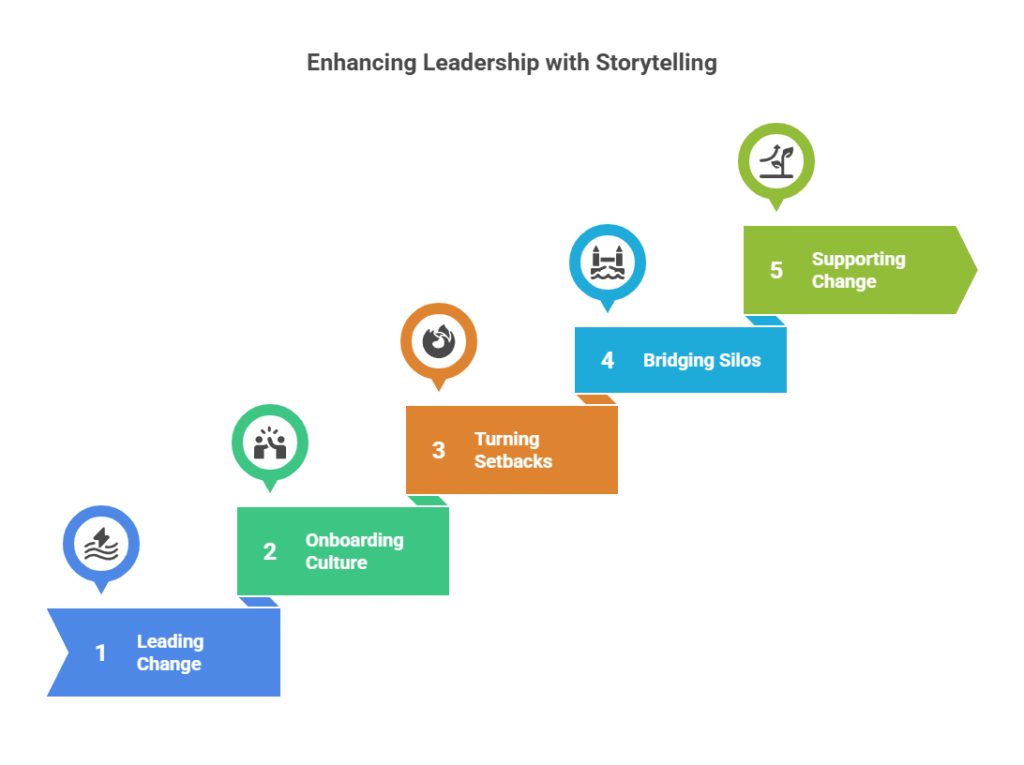
Times to use stories include:
- Leading teams through change to add empathy and context
- Onboarding to make culture authentic and memorable
- Turning setbacks into shared growth moments
- Bridging silos with relatable, cross-team wins
- Supporting change management with real-world examples
Times when storytelling can backfire:
- When speed and clarity are critical
- When delivering complex technical instructions
- When the story is too leader-focused
- When the tone or context doesn’t fit the audience
As with any communication, cultural norms and context matter. Stories that resonate in one region or function may need adjustments elsewhere to avoid confusion or unintended meanings.
The delivery matters too. A story that works in one department may fall flat in another. Leadership training should teach teams how to tailor tone, length, and examples to their audience. Feedback loops help refine delivery over time and make storytelling a skill that can be taught, practiced, and improved through structured leadership development.
How to Train Leaders to Tell Better Stories
To make storytelling a core leadership skill, it needs to be built into leadership development with intention. Storytelling works best when paired with other leadership development pillars, such as performance coaching, change management communication, and feedback training. Together, these skills help leaders create clarity, foster trust, and drive behavioral change at scale.
Practical ways to build storytelling into leadership development:
- Introduce frameworks during change management or communication training
- Use prompts and peer sessions to shape and share stories
- Create space to practice in real team settings
- Teach leaders to adapt stories for different audiences
To make storytelling easier for leaders to apply, especially in high-pressure situations, using a simple structure can be helpful. The CARE Model offers a practical way to organize leadership stories that connect emotionally, reinforce key messages, and build clarity across teams.
The CARE Model: A Storytelling Framework for Leaders
| Stage | Purpose | Prompt Questions |
| C – Context | Set the scene and show relevance | What was happening? Who was involved? Why does this matter? |
| A – Action | Describe the challenge or turning point | What happened? What decision or struggle was faced? What did you or the team do? |
| R – Result | Share the outcome or insight | What changed? What was learned? How did the team grow? |
| E – Emphasis | Tie it back to strategy, values, or a specific takeaway | Why does this story matter? What behavior or mindset does it reinforce? What do you want others to take from it? |
For example, a leader might share how a stalled project (Context) turned around after a team member suggested a minor process tweak (Action). The change saved two weeks on delivery (Result) and reminded the team that speaking up can lead to real impact (Emphasis).
The CARE Model not only helps leaders stay focused. It also supports consistency across teams, strengthens communication, and builds alignment with core strategy and values.
Start small. One story with a clear takeaway is all it takes to build confidence.
As leaders get more comfortable with storytelling, it becomes part of their leadership voice. That’s how they show up, shape culture, and drive engagement.
When storytelling becomes part of the leadership training process, the benefits are easy to spot. Internal communications become more engaging. Leaders show up with greater presence and authenticity. Strategic messages land with clarity. And teams walk away remembering what matters most.
How Leaders Make Storytelling a Daily Habit
Even the best training fades without reinforcement. To make storytelling last, leaders need chances to use it in real conversations, not just in workshops. When storytelling becomes part of everyday communication, it helps leaders show up with clarity, empathy, and purpose.
To reinforce storytelling as a regular leadership behavior:
- Share stories across teams and roles
- Open meetings with short, meaningful stories
- Create forums for leaders to exchange story insights
- Have senior leaders model storytelling in communications
As leaders use stories more frequently, they become part of how teams interpret strategy, values, and expectations. These stories act as shorthand, anchoring complex ideas in real-world examples.
It’s not just about telling stories either. Great leaders learn to spot stories in what their teams share, surfacing insights that might otherwise go unnoticed.
Want to know if storytelling is working? Try the following:
- Survey engagement after story-based messages
- Track retention during onboarding
- Use pulse checks to gauge story impact
Of course, storytelling isn’t the answer to every leadership challenge. But when paired with strong strategy and execution, it becomes one of the most effective tools for building trust and clarity.
This everyday use turns storytelling from a training skill into an organizational habit.
How Storytelling Shapes Organizational Culture
When storytelling becomes part of the culture, it shows up everywhere, from how initiatives are introduced to how values are taught. Leaders use it not because they’re told to, but because it’s how they naturally connect strategy to meaning.
You’ll know storytelling is embedded in leadership culture when:
- New initiatives include a narrative, not just a plan
- Leaders explain decisions with real stories
- All-hands meetings mix metrics with meaning
- Onboarding includes value-driven story examples
To support this kind of culture, organizations need systems that keep stories visible and shareable.
This includes:
- Adding storytelling to leadership competency models
- Capturing key stories in internal platforms
- Using consistent storytelling across all initiatives
When storytelling becomes second nature, leaders don’t just direct work; they build a shared vision. That’s the mark of a culture where stories drive performance and purpose.
Why Storytelling Should Be a Core Part of Leadership Development
The most effective leaders don’t just hand out assignments. They create meaning. Storytelling helps them align teams, drive action, and inspire loyalty.
It’s not a soft skill. It’s a strategic one. And it becomes even more valuable when scaled across teams.
When organizations invest in storytelling as a core leadership capability, they see stronger communication, faster alignment, and clearer cultural continuity. But only when the training goes beyond one workshop or one department.
At Educate 360, we help organizations make storytelling a core part of leadership development. Without it, strategies risk being misunderstood or ignored. When leaders use storytelling effectively, they foster clarity, connection, and shared purpose across teams.
Discover how Educate 360 can help your organization build better leaders, one story at a time.