New Horizons
 Project Management Academy
 Six Sigma Online
 TCM Security
 TRACOM
 Velopi
 Watermark Learning
 Login
Login



Key Takeaways
- Decision-Focused Reviews: Learning updates should drive leadership choices, not recap activity
- Readiness Over Activity: Leaders care about capability gaps and risk, not course counts
- Clear Priorities: Reviews need focus to prevent drift and stalled decisions
- Performance Alignment: Learning earns attention when it connects to results and ownership
- Visible Ownership: Capability improves when leaders make clear learning investment decisions
Executive learning reviews often begin with good intentions. Learning leaders prepare thoughtful updates to show progress, effort, and participation across programs. Leaders leave informed about what happened, yet unclear about what should happen next.
Over time, these updates become reporting rituals. Slides track courses delivered, attendance, and completion rates. Visibility improves, but direction doesn’t, and learning discussions remain focused on updates instead of decisions.
This challenge surfaced at XentinelWave, where learning updates consistently filled executive agendas without shaping decisions. Leaders understood the activity but lacked clarity on capability readiness, risk exposure, and where to invest next. The review informed the room, but it didn’t guide it.
Learning reviews can serve a stronger purpose, but only when they move beyond reporting and into decision-making. When designed as decision environments, they help leaders steer capability, align investment with strategy, and move the organization forward with intent.
When Learning Reviews Feel Complete but Go Nowhere
Learning reviews often feel complete. The updates are clear, the slides are polished, and the agenda gets checked off. When the meeting ends, leaders still struggle to point to a decision that changed anything, or even agree on what should happen next.
These reviews usually follow a familiar pattern. Learning teams walk through activity metrics, progress updates, and recent highlights. The information is accurate and well prepared, yet the discussion rarely shifts beyond what already happened.
Part of the reason this pattern persists is that reporting feels predictable. Activity can be explained, progress is easy to quantify, and effort can be demonstrated without forcing tradeoffs. In environments where time is limited and stakes are high, predictability often wins over ambiguity.
Leaders eventually begin to notice the same signals repeating from one review to the next:
- Activity Emphasis: Updates focus on what was delivered, not what changed
- Metric Visibility: Participation is reported without clear implications
- Descriptive Discussion: Conversation explains effort instead of setting direction
- Unclear Close: Meetings end without a shared next step
At XentinelWave, leaders noticed how consistent these reviews felt from quarter to quarter. The updates were polished and thorough, yet discussions often ended without a shared sense of where the organization should focus next. Over time, the meeting became more about staying informed than moving anything forward.
When reporting becomes the default, it subtly reshapes expectations. The review starts to function as a summary session rather than a decision forum. Over time, leaders begin to view learning updates as confirmation of activity rather than a test of organizational readiness.
The Questions Executives Bring into Learning Reviews
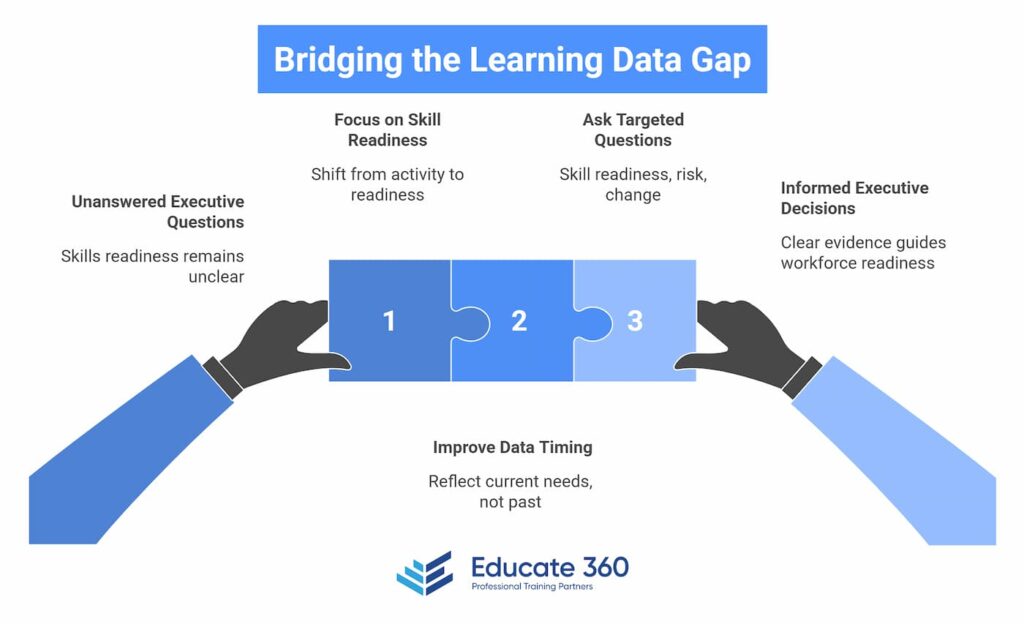
Executives often leave learning reviews with open questions. They can see which programs ran and who took part, but they still don’t know whether critical skills are in place. When a review can’t answer that, leaders are left guessing about what the workforce can handle next.
In the room, executive attention shifts quickly from activity to readiness. Leaders are less concerned with how much learning occurred and more concerned with whether the organization is prepared for current and upcoming demands. The gap becomes clear when business priorities shift faster than learning updates can explain.
Part of the challenge is timing. Learning data often reflects what was delivered months earlier, while executives are focused on what needs to work now. By the time results reach the review, leaders are already asking questions that the data was not designed to answer.
The same questions tend to surface across reviews, even when the data changes:
- Skill Readiness: Which skills are solid today, and which aren’t
- Risk Exposure: Where gaps create near-term risk
- Observed Change: What has improved versus what remains unchanged
- Leadership Focus: Which areas need attention now
At XentinelWave, executive questions increasingly centered on skill readiness rather than learning volume. Leaders wanted to know where confidence was warranted and where gaps might slow execution. The available data showed activity clearly, but it rarely answered those questions directly.
Many leaders leave the meeting with numbers and updates, yet still feel unsure about the team’s true readiness. It becomes harder to tell which skills can handle pressure and which ones might break down. When that line is blurry, big decisions start to lean on instinct instead of clear evidence.
Why Good Discussions Still Miss Decisions
Even when leaders want to make decisions, learning reviews can drift. Conversation jumps between metrics, examples, and questions, but nothing pulls it together. By the time the meeting ends, the group has seen plenty of information and made few clear choices.
Without a shared structure, discussions tend to react to whatever surfaces first. A strong metric draws attention, an anecdote shifts focus, and new questions reset the conversation. Each point may be valid, but the sequence works against clarity.
The deeper issue isn’t confusion. It’s cognitive overload. Leaders are asked to interpret activity data, assess skill readiness, consider performance impact, and weigh tradeoffs in real time. When information arrives without hierarchy, the brain defaults to what feels most recent or most vivid rather than what matters most.
When this happens, leaders often notice the same patterns unfolding:
- Shifting Focus: Attention jumps from one data point to another without resolution
- Late Questions: New questions surface near the end, reopening earlier discussion
- Uneven Weight: Individual anecdotes carry more influence than shared context
- Deferred Closure: Topics are acknowledged but left open for “later”
Over time, this pattern affects judgment. Leaders leave with impressions rather than conclusions and without a clear sense of what matters most. When too many signals compete at once, priority becomes guesswork. Even experienced leaders can struggle to judge which gaps pose the greatest risk. Confidence in how learning connects to performance begins to weaken.
The Missing Link Between Learning and Performance
Learning updates often sound positive on paper. Participation is high, feedback looks encouraging, and programs appear well attended. Still, leaders struggle to connect those updates to changes in performance or responsibility.
In practice, learning data is often asked to stand in for impact. Completion rates and survey responses are presented as signs of progress, even when performance outcomes remain unclear. Over time, leaders begin to sense that something important is missing from the conversation.
This tension is most evident when results disappoint. Leaders revisit learning updates, seeking an explanation, only to find that activity metrics can’t account for the performance gaps. The data explains effort, but not effect.
Leaders frequently encounter the same disconnect:
- Readiness Assumptions: Participation is treated as proof of capability
- Feedback Substitution: Positive sentiment stands in for results
- Volume Bias: Program count is mistaken for progress
- Ownership Gaps: Responsibility is implied rather than named
At XentinelWave, learning discussions often stopped just short of performance conversations. Leaders reviewed participation and feedback with interest, but those updates were rarely examined alongside business results. As a result, learning felt present in the review, while its role in outcomes remained harder to see.
When learning stays separate from performance, ownership stays unclear. Leaders may recognize effort, but the link to results often remains hard to trace. As the gap widens, it becomes harder to decide where to invest and what to change.
What Helps Decisions Finally Surface
Many learning reviews aren’t short on information. The challenge is knowing what leaders are expected to decide once the discussion ends. When that expectation is unclear, meetings drift toward observation instead of action.
Good intentions alone don’t create decisions. In most cases, leaders understand that learning should influence direction. Hesitation tends to appear when choosing a direction requires naming tradeoffs, reallocating attention, or signaling that certain priorities will receive less focus.
This is where the tension shifts from process to leadership. Reaching a decision means declaring what matters most right now. It also means acknowledging what won’t receive the same investment, which can expose gaps, create discomfort, or invite scrutiny.
When discussions approach this point, familiar patterns often reappear:
- Decision Diffusion: Responsibility spreads across the group rather than settling with one leader
- Tradeoff Avoidance: Competing priorities are acknowledged but not ranked
- Polite Agreement: Heads nod without a clear commitment
- Delayed Ownership: Follow-up is implied instead of named
At XentinelWave, leaders acknowledged the need for clearer decisions in learning reviews. Once the conversation approached priority shifts or ownership, momentum slowed. The intent to decide was present, yet commitment required more clarity than the room was prepared to offer.
When decision moments remain unclaimed, the review continues without friction on the surface. Beneath that calm, uncertainty lingers around what matters most and who will act. Alignment in tone is common, but alignment in commitment isn’t.
When Learning Reviews Begin to Feel Different
Shifting the way learning reviews work can feel uncomfortable. Teams are meant for sharing updates, not for asking leaders to make choices in the room. Without a clear change in purpose, reviews tend to fall back into familiar patterns.
Early changes often feel subtle rather than dramatic. Discussions slow slightly, questions become more direct, and uncertainty becomes easier to acknowledge. These moments signal a shift in how the review is being used, even before results appear.
Teams often notice small but telling signals during this shift:
- Discussion Pace: Fewer updates, more deliberate conversation
- Question Quality: Leaders ask clearer, more pointed questions
- Shared Focus: Attention narrows to fewer, more meaningful issues
As teams start to question how these reviews work, the change can feel subtle at first. The conversation slows, expectations change, and familiar patterns become easier to spot. This is often the point where leaders notice the meeting feels different, even if they can’t yet explain why.
When Learning Reviews Start Steering Capability
Learning reviews shape outcomes when they focus on decisions rather than updates. Reporting informs, but decisions set direction and create accountability. Organizations that make this change often see stronger engagement and earlier visibility into skill gaps.
Six to twelve months after reframing learning reviews this way, leaders typically describe a different kind of conversation. Fewer updates dominate the agenda, and more time is spent deciding what to address, reinforce, or change. The review becomes a place where capability is actively shaped instead of passively observed.
Educate 360 works with organizations to design learning conversations that strengthen leadership, process, and technology capability together. When learning reviews help leaders decide, they stop reporting on capability and start shaping it.