New Horizons
 Project Management Academy
 Six Sigma Online
 TCM Security
 TRACOM
 Velopi
 Watermark Learning
 Login
Login



Most training launches with shared intent and good intentions. Leaders at different levels align around a new skill or framework and introduce fresh language into meetings and planning discussions. For a brief period, it feels like the organization is moving in the same direction.
Then daily pressure returns. Targets demand attention, work accelerates, and familiar habits begin to take over again. What felt unified at launch starts to fragment across teams.
XentinelWave experienced this shift after launching a leadership initiative designed to strengthen how work was carried out across the organization. Participation was strong and early conversations reflected the new skills and frameworks.
Within weeks, leadership discussions revealed uneven application. Some teams integrated the changes into how they operated. Others slipped back into prior routines.
The issue wasn’t effort or understanding. It was reinforcement. When leaders don’t revisit new skills in reviews, planning sessions, and day-to-day conversations, learning remains an initiative instead of shaping daily work.
Drift after training is predictable. Preventing it takes more than endorsement at launch. It requires reinforcement woven into leadership behavior at every level.
How Reinforcement Sustains New Skills
New skills don’t disappear because people reject them. They fade when already established routines, priorities, and ways of working resurface. Once familiar patterns resume, new approaches must fight for space in daily work.
Most training programs introduce updated approaches and frameworks. Participants leave with shared language and practical tools. The real test comes when those tools encounter systems and expectations that were already in place.
Over time, predictable forces pull attention away from newly introduced behaviors.
Why Skills Fade After Training
- Competing Priorities: Urgent demands push new practices to the margins
- Existing Metrics: Leaders focus on measures already tied to performance
- Routine Comfort: Familiar approaches feel faster under pressure
- Limited Reinforcement: Skills not revisited in meetings lose traction
None of these forces signal resistance or failure. They reflect habits taking hold and reinforcing what already feels familiar. Without reinforcement, leaders default to established routines, and consistency across teams weakens.
Many organizations interpret participation as progress. Once people attend training and understand the material, leaders assume behavior will change on its own. The gap between understanding a skill and seeing it used consistently in meetings, decisions, and daily interactions often goes unnoticed until performance fails to improve.
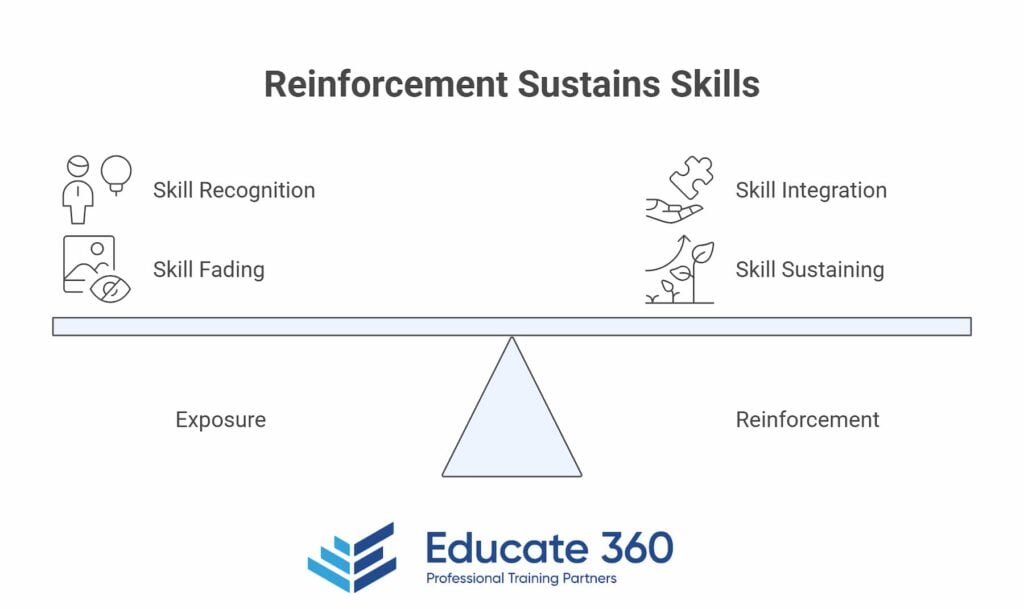
The Difference Between Exposure and Reinforcement
Early signs after training often look encouraging. New terminology appears in documents, teams reference the framework in conversations, and work begins to shift in practice. The question is whether those signals persist once attention moves elsewhere.
Familiarity with the concepts can look a lot like adoption. When people can describe the skill, explain when it should be used, and demonstrate it in isolated moments, leaders assume consistent application will follow. Those early examples often feel like evidence of lasting change.
As weeks pass, the language fades from regular use and the framework surfaces only when someone prompts it. Skills that once shaped conversations begin competing with established routines that require no adjustment.
The distinction lies in what continues without prompting. In practice, the difference looks like this:
Exposure vs. Reinforcement in Practice
- Exposure: Employees attend training and understand the concepts
- Early Visibility: Skills appear in isolated examples while still recent
- Reinforcement: Leaders reintroduce the skills through expectations, feedback, and workflow
- Integration: The skills influence how work is evaluated, prioritized, and executed
Exposure creates recognition. Reinforcement sustains repetition.
When exposure is mistaken for reinforcement, leaders assume progress because people can describe the skill. Months later, decisions return to familiar patterns and results remain unchanged. The difference appears in what continues once attention shifts.
How Reinforcement Shapes Performance
In environments where reinforcement is clear, managers know what to look for and what to reinforce. New skills show up in how work is discussed, delegated, and reviewed. Follow-up conversations happen without being scheduled because expectations are already part of the rhythm.
When reinforcement is unclear, adoption begins to vary. Some managers continue building on the training, while others return to established habits. The difference may not be obvious at first, but it becomes more visible as time passes.
The contrast becomes easier to see when you compare the two environments.
When Reinforcement Is Clear
- Behavior Visibility: Managers know what to observe and reinforce
- Natural Follow-Up: Conversations build on the training without forced reminders
- Skill Integration: New skills appear in meetings, reviews, and workflow
- Improved Decisions: Delegation and prioritization reflect new standards
When Reinforcement Is Unclear
- Adoption Variance: Application differs from team to team
- Manager Discretion: Some leaders build on the training while others move on
- Recurring Challenges: The same issues resurface despite prior instruction
It usually comes down to how often the skills are brought back into the work.
Stable performance doesn’t happen by accident. It grows from leaders who revisit skills and hold others accountable for applying them long after the training concludes. The question is whether that standard holds across your teams or varies from one manager to the next.
Assessing Reinforcement Across Teams
Reinforcement doesn’t always show up in formal metrics. Most organizations track attendance, completion rates, and participant feedback. Those indicators show participation, but they don’t reveal whether new skills remain active in daily work.
Assessing reinforcement requires looking at behavior over time. The question isn’t whether people enjoyed the training or understood the material. It’s whether the skills continue shaping how work is carried out weeks and months later.
Questions to Evaluate Reinforcement
- Behavior Consistency: Do new capabilities appear regularly in meetings, documents, and decisions
- Manager Follow-Up: Are leaders referencing the training during coaching and reviews
- Cross-Team Alignment: Is adoption similar across managers, or does it vary widely
- Performance Connection: Have the skills been tied to expectations and evaluation standards
These questions shift the focus from intent to evidence. Reinforcement becomes visible in patterns, not promises.
If answers differ significantly across teams, reinforcement isn’t yet embedded. Skills may depend on individual managers rather than shared leadership expectations. Until reinforcement is applied consistently, outcomes will continue to vary.
The Stages of Reinforcement Growth
Not every team reinforces training the same way. In some areas, the skills continue shaping how work gets done, while in others, teams slip back into old habits. The difference comes down to how consistently leaders bring the skills back into everyday work.
Reinforcement develops gradually. It doesn’t move from launch to consistency overnight. Most organizations move through a series of stages as reinforcement becomes more deliberate and more embedded in daily management practice.
Stage 1 — Training Delivered
- High Energy: Participants leave aligned and motivated
- Shared Understanding: Teams grasp the skills introduced
- Fragile Momentum: Application depends on individual initiative
Stage 2 — Occasional Follow-Up
- Selective Reinforcement: Some managers revisit the material
- Inconsistent Conversations: References vary by team
- Uneven Progress: Adoption differs across groups
Stage 3 — Structured Check-Ins
- Intentional Follow-Up: Managers ask about application in real work
- Expectation Alignment: Skills connect to responsibilities and outcomes
- Emerging Stability: Reinforcement becomes more predictable
Stage 4 — Skills Integrated into Workflow
- Reliable Application: New behaviors appear consistently
- Embedded Standards: Skills guide delegation and feedback
- Reduced Variance: Teams operate with shared expectations
Stage 5 — Learning Becomes Part of Culture
- Leadership Expectation: Reinforcement is built into performance conversations
- Ongoing Development: Growth extends beyond isolated events
- Sustained Consistency: Skills remain embedded in daily leadership practice
Most organizations find themselves between Stages 2 and 3, where reinforcement depends more on individual managers than shared expectations. Progress from that point depends on managers seeing reinforcement as core to how they lead, not as an added responsibility.
Making Reinforcement a Leadership Priority
Managers are more likely to reinforce learning when they see how it strengthens their own effectiveness. If reinforcement feels like an added responsibility, it competes with other priorities. As it sharpens how managers lead, it becomes embedded in their everyday approach.
Reinforcement is not just a benefit to the organization. It improves how managers evaluate performance, guide conversations, and align expectations. When leaders see reinforcement as a tool that strengthens their own effectiveness, it shifts from obligation to advantage.
What Reinforcement Strengthens
- Better Decisions: Shared structure improves evaluation
- Fewer Repeated Mistakes: Expectations are reinforced early
- Greater Ownership: Performance standards are understood
- Focused Meetings: Discussions stay tied to agreed standards
A. Senior Leaders Set the Tone
- Leadership Attention: What senior leaders revisit signals priority
- Skill Referencing: Questions about application reinforce expectations
- Recognition Signals: Acknowledging follow-through sets a standard
- Priority Alignment: Continued discussion sustains importance
B. Make Reinforcement Simple
- 1:1 Prompts: Short questions tied to specific skills
- Behavior Summaries: Quick reminders of what to watch for
- Concrete Examples: Illustrations of strong application
- Review Language: Feedback connected to the skills
C. Connect Reinforcement to Identity
- Role Framing: Shift from sending to supporting growth
- Leadership Ownership: Make development part of the role
- Consistency Shift: Move from events to ongoing practice
When reinforcement shifts from an added task to standard leadership practice, results begin to stabilize. This change doesn’t require new content. It requires consistent follow-up that keeps skills connected to real work. The impact becomes evident when you see how it plays out in practice.
Putting Reinforcement into Practice
Reinforcement isn’t noticeable when it changes how teams make decisions and execute work. Differences in follow-up and expectations begin to show up in daily operations. Over time, those gaps either narrow through consistent leadership attention or widen through uneven application.
This pattern became apparent at XentinelWave after leaders introduced a leadership training program designed to improve decision quality across departments. Participation was high, and teams left with a shared framework.
In the weeks that followed, adoption varied. Some managers applied the framework consistently. Others returned to familiar routines.
The training itself hadn’t changed, and the variation reflected what happened after launch. Leadership responded with targeted adjustments rather than redesigning the program.
What Changed
- Manager Guide: A short reference outlining behaviors to reinforce
- Structured Prompts: Follow-up questions tied to real decisions
- Operational References: Decision standards included in leadership reviews
Within months, meeting structure improved and decision-making became more consistent across departments. Delegation became more defined, recurring issues decreased, and operational reviews reflected fewer unresolved debates. The gains held because reinforcement shaped what leaders did after the launch, not just how they introduced it.
Reinforcement Turns Training Into Results
Training launches change. Reinforcement decides whether it lasts. The months that follow determine whether new behaviors take root or drift back toward familiar patterns. It defines whether learning remains an event or shapes how work is carried out.
Sustained improvement doesn’t require constant new programs. It depends on leaders at every level reinforcing the skills they expect to see. Over six to twelve months, consistent follow-up can lead to better decisions, greater accountability, and fewer repeated challenges across teams.
Educate 360 helps organizations design leadership development that extends beyond the training room. By aligning skill development with reinforcement strategies that fit into real workflows, leadership teams can translate learning into measurable performance gains.
If you are ready to move beyond event-based training, partner with Educate 360 to build reinforcement into how your leaders operate.