New Horizons
 Project Management Academy
 Six Sigma Online
 TCM Security
 TRACOM
 Velopi
 Watermark Learning
 Login
Login



Key Takeaways:
- Upskilling Focus: Builds skills for current roles.
- Reskilling Path: Prepares employees for new roles.
- Hybrid Skills: Blending tech and human skills adds value.
- Skills Assessment: Map skills to business goals first.
- Strategic Alignment: Clear strategy prevents turnover.
When Job Roles Evolve or Disappear
Organizations face constant pressure to adapt as markets evolve, technology advances, and customer expectations continue to grow. This continuous evolution means job roles rarely stay static.
Some expand in scope, requiring employees to learn new tools and practices. Others disappear entirely, replaced by different functions or consolidated into new positions. For leaders, the challenge is ensuring employees remain engaged rather than overwhelmed during these shifts.
At SentinelWave, a mid-sized company, expansion brought new service offerings that disrupted the workforce. Some employees needed advanced product knowledge to keep pace with evolving responsibilities. Others discovered their old tasks were consolidated or replaced, forcing them into unfamiliar roles. With no clear guidance, uncertainty grew and turnover spiked.
This scenario highlights the importance of both upskilling and reskilling in workforce development. Upskilling ensures employees remain current in their existing positions. Reskilling provides a pathway into entirely new opportunities. Together, these strategies form the foundation of effective workforce development, helping organizations stay competitive in a tech-driven economy where adaptability is everything.

Clearing Confusion: Upskilling vs. Reskilling
The terms upskilling and reskilling are often treated as if they mean the same thing, but they serve different purposes. Without clear distinctions, training efforts can fall out of sync with business needs, leaving employees unsure of what’s expected. When leaders take the time to draw that line, they build trust and create stronger engagement.
The distinction matters for effective career mobility:
Upskilling means enhancing skills for current or future needs within the same role. For example:
- Company example: Sales representatives trained on new product lines and consultative selling.
- Industry example: A marketer learning GA4 or generative AI tools.
Reskilling means developing skills to shift into an entirely new role. For example:
- Company example: Inventory coordinators retrained to move into customer relations or quality assurance.
- Industry example: A call center employee transitioning to IT support.
At SentinelWave, confusion grew when leadership labeled everything as ‘training.’ Employees who needed new skills felt unfairly judged as poor performers, while others facing role changes felt blindsided. As one employee shared, “When I was told I had to train, I thought it meant I wasn’t good enough at my job. No one explained it was about preparing me for the future.”
Confusing the two leads to frustration and wasted effort. Clear communication about what type of professional development employees are receiving, and why, helps build trust during transitions. Once employees understand the difference, leaders can explore how combining skill sets creates even greater value.
Building Hybrid Professionals for a Competitive Edge
Workplace value is no longer measured solely by technical skills. Employees who succeed in today’s environment bring a mix of expertise, adaptability, and human skills that allow them to respond quickly to new challenges. This hybrid skill set creates professionals who are more versatile and more valuable.
Hybrid talent elevates an organization and expands its ability to adapt. The breakthrough at SentinelWave came when leadership realized that their most valuable employees weren’t just technically strong or task-focused. Instead, their standouts blended operational expertise with adaptability and interpersonal skills.
Think of hybrid skills as puzzle pieces. Alone, they have value. Together, they create a new picture that’s stronger than either piece by itself.
Today’s most valuable professionals combine:
- Technical skills
- Domain expertise
- Human-centered capabilities like communication and problem-solving
As AI handles more routine tasks, this convergence is becoming increasingly critical. Humans thrive when they connect knowledge across domains. They make strategic judgments and collaborate to solve complex problems.
Upskilling Examples:
- Sales rep + market analysis = Strategic advisor
- Data analyst + storytelling = Data strategist
- Project manager + change management = Digital transformation lead
- HR professional + data literacy = People analytics advisor
Reskilling Examples:
- Inventory coordinator + relationship management = Customer success specialist
- Customer service rep + coding = Customer success automation specialist
- Finance analyst + strategic planning = Business development manager
- Administrative assistant + digital project tools = Operations coordinator
These combinations show how skills that once seemed unrelated can merge to create entirely new, high-value roles. Developing strong hybrid skills helps employees adapt to change. More importantly, it allows organizations to anticipate it. Leaders who recognize and develop hybrid combinations create employees who drive innovation rather than respond to it.
To identify which hybrid skills matter most, organizations must begin with a thoughtful talent development strategy that aligns with future workforce needs.

Assess Before You Invest in Upskilling and Reskilling
Deciding whether upskilling or reskilling should come first requires careful analysis. Jumping straight into training without a plan can waste resources and confuse employees. Organizations that start with a clear assessment avoid these pitfalls and align their investments with strategy.
Before announcing expansions, SentinelWave should have taken a step back to understand its workforce landscape. Without a skills strategy, even the best technology and leadership can fail because process alignment is missing.
A strong assessment includes:
- Skills inventories and reviews: What employees know and how they’re performing
- Talent forecasts: Who’s excelling, struggling, and where growth lies
- Business strategy review: Consider automation, mergers, and new markets
- Turnover analysis: Who’s leaving and why
- Learning partnerships: Collaborate with training experts to design pathways
Applied to SentinelWave, this process would map current skills against future needs. Leaders could then identify which employees could grow within their roles through upskilling. They could also determine which employees needed reskilling for entirely new career paths.
Proactive workforce planning reduces disruption and improves retention. Without it, companies risk repeating the same missteps that SentinelWave encountered.
Avoiding Costly Missteps in Upskilling and Reskilling Programs
Training initiatives often fail not because of intent, but because of execution. Common errors limit impact and damage employee trust. By learning from these mistakes, leaders can design programs that feel like opportunities instead of burdens.
SentinelWave’s hurried approach introduced several avoidable problems. Other organizations can learn from these common mistakes:
- Focusing only on top performers: They trained only high-performing sales reps on new product lines, leaving the rest of the team behind.
- Assuming everyone wants the same role: They never asked inventory coordinators if customer-facing roles interested them.
- Overloading without support: Employees were expected to master new skills without mentoring, practice, or stretch projects.
- Framing reskilling as punishment: Career shifts were described as “necessary adjustments” instead of growth opportunities.
Each of these missteps weakened trust and created resistance. Workforce development programs succeed when they view training as an investment in every employee, not just an elite few. The challenge then becomes designing programs that inspire employees and create mobility instead of anxiety.
Motivating Employees Through Career Growth and Mobility
Employee motivation is the true fuel of any upskilling or reskilling effort. Without it, programs feel like extra work. With it, they feel like they have growth opportunities. When organizations show employees a clear path forward and connect training to long-term career mobility, they transform anxiety into enthusiasm.
The turning point at SentinelWave came when leaders shifted from assigning tasks to creating growth paths. Instead of treating development as a burden, they reframed it as a career journey.
They introduced:
- Learning paths tied to transitions: Clear roadmaps showed how skills led to new opportunities in sales, customer relations, and operations management.
- Manager coaching: Leaders learned how to support career development conversations and spot growth potential.
- Recognition and rewards: Certificates, new project roles, and public shout-outs celebrated milestones.
- Soft skill integration: Training went beyond technical content to build adaptability, communication, and problem-solving.
Recognition deserves special attention. Too often, employees complete training with little acknowledgment.
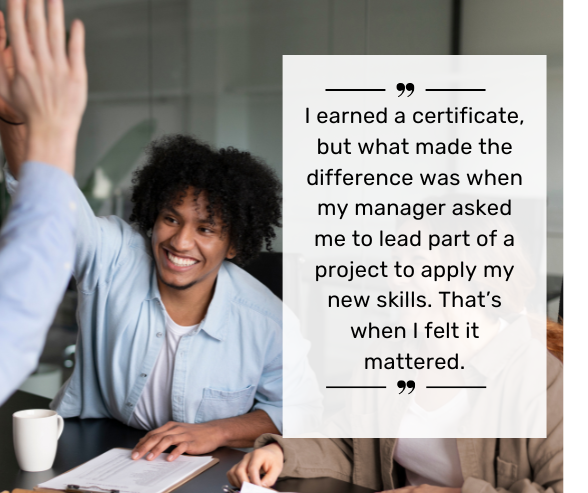
Forms of recognition include digital badges, certifications, leadership endorsements, and opportunities to present new skills in team meetings. Each reinforces the message that progress matters.
Soft skills are a vital complement to technical expertise. Communication, problem-solving, and adaptability often determine how effectively technical knowledge is applied in practice. An employee who masters a new software tool but cannot explain its value to teammates may struggle to gain support or drive adoption. By combining technical and soft skills, organizations equip employees not only to perform but also to influence and lead.
Through its focus on motivation and mobility, SentinelWave transformed workforce anxiety into enthusiasm for growth. Employees saw both upskilling and reskilling as opportunities for advancement. With that cultural shift, the company could finally align its training strategy with long-term workforce development and business growth.
Choosing the Right Upskilling and Reskilling Strategy at the Right Time
Upskilling and reskilling are not one-time projects. They are ongoing commitments that should align with organizational goals and employee aspirations. The right balance depends on timing, business direction, and workforce readiness.
When SentinelWave built a clear strategy, the results came quickly. Sales representatives grew into consultative advisors, blending product knowledge with market insight. Former inventory coordinators became customer success specialists and quality assurance leaders. Turnover dropped as employees recognized clear pathways for advancement.
The lesson is clear: upskilling and reskilling are not competing priorities but complementary strategies. The right investment depends on where your business is headed and what your employees aspire to achieve. Organizations that commit to continuous workforce development position themselves to meet tomorrow’s challenges with confidence.
That’s where Educate 360 comes in. We help organizations align leadership, process, and technology by building the skills needed for long-term success. With customizable training programs built to align with your business strategy, our experts ensure teams are ready to thrive through change.
Start today with Educate 360’s tailored programs and turn skill development into a lasting business advantage.