
 New Horizons
 Project Management Academy
 Six Sigma Online
 TCM Security
 TRACOM
 Velopi
 Watermark Learning
 Login



Key Takeaways
- Close the readiness gap: AI use is up 10 points this year, while access to learning and development is down 8
- Data readiness is fixable: Only 7% call their data fully AI-ready, a clear target to close
- Visibility makes spend actionable: Connecting cost to usage and value turns spend into a planning tool
- Structure already exists: Governance committees are widespread, with follow-through coming next
- A clear path to Q4 action: Four priorities need budget now, and five questions turn them into a plan
Q4 planning kickoff, and the room splits into four conversations at once.
IT wants to talk deployment timelines. Finance is fixated on the cloud bill. Legal is asking who signs off when an agent takes an action a person used to take. HR is asking who can run it.
Each group thinks they’re raising a unique issue. What they might not notice is that they’re describing the same gap, and the 2027 budgets that depend on closing it are about to lock.
Leaders often read a scene like this as four separate problems competing for the same budget. The more useful read is that everyone in the room is describing the same gap. AI adoption moved faster than the organization’s capacity to run, govern, or staff it.
PwC’s 2026 Global Workforce Hopes and Fears Survey put a number on it. AI use at work climbed to 64% this year, up 10 points from last year. Access to the learning and development resources workers say they need fell to 51%, down from 59%.
What genuinely changed this year is easy to lose inside the research that explains why it matters. Sorting the two apart is where Q4 planning should start, then deciding what needs a commitment now and what’s still worth watching.
What Does It Take to Make Orchestration Work?
Nine months into the year, the AI conversation inside many organizations shifted. The question changed from “Which model do we use?” to “How do we orchestrate multiple models and agents to work together on the same task?”
Orchestration is a coordination problem: agents, tools, and data sources acting on a shared goal instead of running as individual solutions, and it’s the one leaders spent the year trying to solve.
Issues with orchestration show up in common ways:
- Siloed platforms: Data lives in separate systems with no shared schema connecting them
- Inconsistent definitions: The same field means something different depending on which department is looking at it
- Unclear ownership: No one can say with confidence who’s accountable for a given dataset’s accuracy
- Stale pipelines: Built for periodic reporting, not the real-time queries agentic workflows need
Coordinating agents at scale exposed a constraint model selection never had to confront. Multi-step agentic workflows could pull across more systems and data sources than a conventional single-prompt interaction, and much of that data wasn’t built with agents in mind. It stayed usable for periodic reporting and human review, but agentic workflows exposed the gaps.
Only 7% of organizations say their data is completely ready for AI, according to research from Cloudera and Harvard Business Review Analytic Services.
Model capability moved fast enough this year to attempt cross-functional, multi-step work. Data infrastructure didn’t move at the same pace. The same readiness question changes how leaders need to read something they already review every quarter: the cloud bill.
Do Cloud Bills Reveal More Than Rising Costs?
Cloud bills going into Q4 planning can be easy to misread. Higher costs can look like evidence that deployment is scaling. But the total alone can’t show what’s driving the spend, how capacity is being used, or what value it’s producing.
The FinOps Foundation’s 2026 State of FinOps survey found that 98% of surveyed FinOps practitioners now manage AI spend, up from 63% in 2025. AI cost management was also the number-one skillset respondents said their teams need to add.
A cloud total doesn’t answer three questions leaders increasingly need underneath it:
- What’s driving the cost: Which workloads, teams, or use cases are responsible for the increase
- How capacity is being used: Whether provisioned resources match actual workload demand
- What the spend is producing: Whether higher consumption is translating into enough business value to justify it
Getting those answers takes more than cost controls. Teams need to understand how workloads consume infrastructure, monitor utilization, forecast demand, and choose the right deployment environment. Deloitte’s 2026 AI infrastructure research points to the same capability shift, highlighting GPU utilization, inference economics, and hybrid compute costs as areas requiring deeper expertise.
A rising cloud bill isn’t proof that an organization is scaling successfully or wasting capacity. It’s a signal to look underneath the total.
And once organizations can see what AI workloads consume, the next question is what those workloads can access, what actions they can take, and who’s accountable when they act. That’s where the readiness question moves from cost to governance.
Can Governance Keep Pace with AI’s Evolution?
Watching what they’re doing is only the start. Someone still decides what agents can do, who’s accountable when they act alone, and how that gets reviewed. Governance has become the question faster than most organizations were built to handle.
Sedgwick’s 2026 survey of 300 senior Fortune 500 leaders shows two different pictures of AI governance.
Structurally, the numbers look strong: 70% report having AI risk committees, 67% report progress on AI infrastructure, and 41% have a dedicated AI governance team. Operationally, they don’t: only 14% say they’re fully ready for AI deployment.
Risk committees and infrastructure progress are real and widespread. Dedicated governance teams still lag at 41%, and what’s underneath the structure hasn’t kept pace: the processes, controls, and skills that make a governance framework work day to day.
That gap shows up in a few specific, recurring places:
- Identity: Confirming which agent took which action, not just which system it ran on
- Access: Limiting what data and tools an agent can reach based on the task, not standing permissions
- Human-in-the-loop: Defining exactly which decisions still require a person to sign off before an agent acts
- Monitoring boundaries: Knowing when an agent has drifted outside its intended scope, and who gets alerted when it does
A risk committee and a governance team are structural answers. Closing the four gaps above depends on whether the people running those committees have the skills those gaps require.
Why Does Workforce Readiness Need Six Different Fixes?
The people meant to close those governance gaps come from the same workforce that’s supposed to be getting AI-ready, and it isn’t keeping pace with deployment. Readiness has been treated as one broad problem all year. It’s six distinct ones.
Q4 planning can’t fund, staff, or sequence training against a single vague label. Each of the six gaps calls for a different fix, and knowing which one is missing is what turns a diagnosis into a plan.
Six gaps need attention:
- Agent oversight: Knowing how to monitor, audit, and correct an autonomous system’s actions, not review its output alone
- Data and ML fluency: Understanding what makes a dataset usable for an agent, not just accurate for a report
- Workflow redesign skill: Rebuilding a process around what an agent can do, rather than bolting AI onto a process built for people
- Governance literacy: Knowing what oversight an agent needs before it’s deployed, not after something goes wrong
- Platform and deployment capability: Getting a workload from pilot into governed production on the platform it runs on
- Leadership judgment: Deciding where agentic AI belongs in the business and where it doesn’t, a call no dashboard makes for you
Leadership judgment plays a different role among the six, since it influences how the other five get funded, staffed, and prioritized. Without someone making the call, the other five gaps compete for attention with no clear owner deciding what gets addressed first.
A workflow-redesign gap and a leadership-judgment gap need different people, training, and timelines. Q4 planning must separate the internal capabilities that need investment now from external developments that are important to watch before committing real budget.
Which Developments Deserve Action Now, and Which Can Wait?
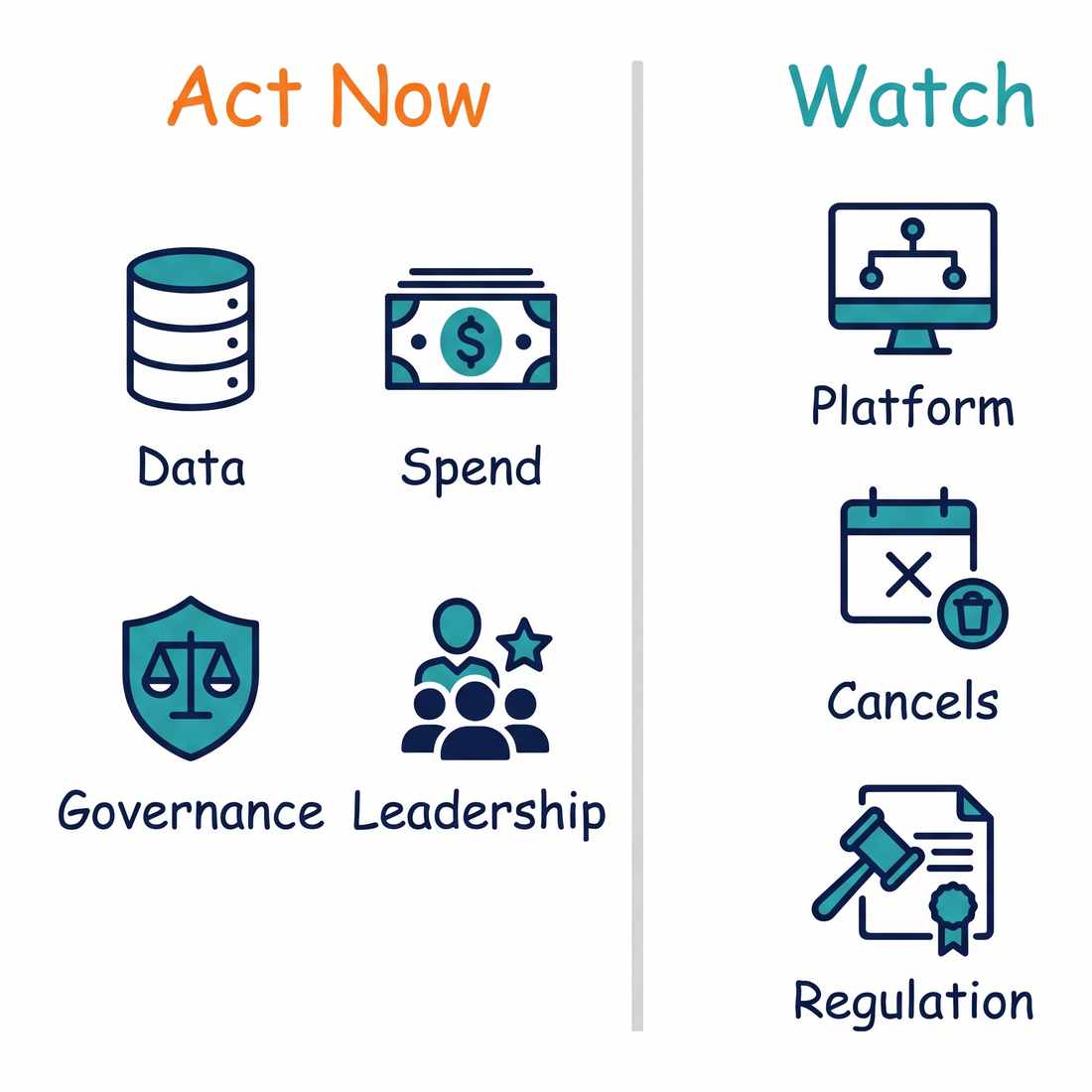
Six capability gaps and a governance shortfall all compete for the same limited 2027 budget and attention. Without a clear way to rank them, a leader risks funding the most familiar problem instead of the one that matters most. Two categories cut through that noise: Act Now and Watch.
Act Now means a development already affects the 2027 budget being set this quarter, workforce capability, architecture, or governance decisions, and waiting only makes it more expensive.
Four priorities:
- Close the data-readiness gap for planned agentic workloads. Only 7% of organizations say their data is completely ready for AI. Fixing this takes real data and ML fluency.
- Build visibility into AI infrastructure spend. Rising cost alone doesn’t show what’s driving it or whether it’s paying off.
- Build operational governance for agents already in production. Identity, access, human-in-the-loop, and monitoring gaps create exposure today, not eventually.
- Put leadership judgment behind the other three. None of them get funded, staffed, or sequenced without someone deciding where agentic AI belongs.
Watch means the direction matters, but it’s shaped by forces outside any one organization’s control, like market maturity, vendor competition, and regulatory timelines, where a major commitment right now would be premature. Tracking it closely enough to avoid being caught flat-footed once it matures isn’t the same as ignoring it.
Three signals:
- Platform strategy: Cloud and hybrid AI options are still evolving. Watch portability, interoperability, and workload requirements before making architecture decisions that are difficult to reverse.
- Agentic project cancellations: Gartner forecasts 40%+ of agentic AI projects canceled by 2027 over cost, unclear value, or inadequate risk controls. Reason for discipline, not for pausing investment.
- Regulatory evolution: Jurisdiction-specific rules are still forming. Track the changes, but meet what already applies now.
These four priorities are internal decisions an organization can act on immediately. The Watch side is different in kind: external conditions no single 2027 budget decision will resolve, though that doesn’t excuse anyone from meeting the requirements already in force.
How Do These Gaps Become a Q4 Plan?
Data readiness, AI spend visibility, governance controls, and leadership judgment each need a plan specific enough that Q4 planning doesn’t become four separate conversations. Gartner forecasts that 40% of enterprise applications will include task-specific AI agents by the end of 2026, up from less than 5% in 2025.
It’s this pace that leaders are planning for, whether their organization is fully prepared. A checklist built to match this pace asks about capability, not adoption.
Five questions matter most:
- Do we have leaders who can decide where agentic AI belongs? Someone makes that call, and the answer determines how the rest of this list gets resourced.
- Do we have people who can build and orchestrate agents on our platforms? Infrastructure alone doesn’t close a deployment gap.
- Do we have the data and ML skill to support them? Usable data doesn’t remain usable without skilled people to maintain it.
- Can teams redesign, deploy, and operate these systems in our real environment? A pilot that works once isn’t the same as a workflow that can run reliably at scale.
- Do governance owners understand how oversight changes as autonomy increases? The controls that worked for a chatbot don’t automatically work for agents with system access.
Answering these questions means identifying who already has each capability, who’s close, and who needs to build it. This inventory, not the deployment numbers alone, is what Q4 planning should be budgeting into 2027.
The Broader Question to Answer in Q4
Q4 planning usually starts with a deployment question: has the organization deployed enough? It’s a fair question, but it’s only half the picture. Activity is easy to measure. Capability isn’t, and it’s the one that decides whether deployment pays off.
The deeper question is whether the organization can run, govern, and staff what it’s already deployed. Without that, deployment can widen gaps in cost visibility, governance readiness, and workforce capability.
Educate 360 partners with organizations and brings together expertise in leadership judgment, data and ML fluency, agent development, platform deployment, and governance. The goal is to build the cross-functional capability the evidence points to, not a training event that looks good on a calendar.
Has your organization deployed enough? Can it run, govern, and staff what’s already there?
If your Q4 planning is still sorting deployment from readiness, we’d welcome the conversation about what cross-functional development looks like for your organization.
AI adoption moved fast this year. Whether your organization is ready is the harder question, and the one that determines what 2027 funds.



 Educate 360
 Pierian Training
 Six Sigma Online
 Velopi

