New Horizons
 Project Management Academy
 Six Sigma Online
 TCM Security
 TRACOM
 Velopi
 Watermark Learning
 Login



AI Use Is Growing. Is the Work Getting Better?
For many organizations, the AI conversation has already moved beyond access.
Employees are experimenting. They’re building prompts, drafting faster, summarizing information, automating routine tasks, and finding new ways to work.
BCG’s 2026 AI at Work survey found that 74% of frontline employees are now regular AI users.1 At the same time, 72% of workers say AI has already considerably changed the skills expected of them in their role.1 Adoption and expectations are both moving fast, but that doesn’t mean an organization has caught up.
Executives now face a new challenge.
The question is no longer:
Are our people using AI?
It’s:
Is AI changing the work in ways that improve business performance?
Employees using AI every day doesn’t guarantee workflows improve. A team can save time without knowing where to redirect their increased capacity. Training a workforce means little without a shared standard for where AI belongs, how leaders judge quality, or what outcome should improve.
The AI adoption gap is the distance between:
AI access → AI use → better work → measurable business value
Closing the gap requires more than deploying tools or counting course completions. It requires connecting workforce capability to the actual roles, workflows, standards, and outcomes that shape how the organization operates.
The executive takeaway: Individual AI capability creates potential. Business value appears when capability becomes a better, repeatable way of working.
The Real Unit of AI Adoption Is the Workflow
AI often creates value first at the individual-task level.
Marketers create drafts faster. Analysts summarize research data. Project managers create first-pass plans. IT teams triage support tickets faster.
Those improvements matter. But faster task completion doesn’t automatically create a better workflow. An employee may accelerate one step while the reviewer, approver, downstream team, or system continues working exactly as before. The result is a new bottleneck.
Consider the full workflow:
- TASK: What can AI help someone do better?
- HANDOFF: How does the output move to the next person?
- REVIEW: How do you evaluate quality, accuracy, or risk?
- DECISION: What still requires human judgment?
- OUTCOME: What business result should improve?
AI adoption remains local if only the first step changes. It becomes organizational capability when the entire workflow improves.
Why this matters
BCG found that 67% of employees at organizations redesigning workflows with AI reported measurable business improvement, compared with 43% at organizations primarily focused on deploying tools.1
The executive question shifts. Instead of asking:
“How many employees are using AI?”
Ask:
“Which workflows are better because of it?”
What It Takes to Close the Adoption Gap
When AI activity is high but impact is inconsistent, it usually isn’t due to a single issue. Five gaps commonly separate individual use from organization-wide value. Four relate to how work is set up, and one runs underneath them all.
1. Prioritizing the Right Work
Employees have access to AI, but they may not know which tasks, decisions, or processes are most worth improving. Without business priorities and relevant use cases, untargeted efforts spread thin.
Executive question: Which work should AI help us improve first?
2. Connecting Learning to the Job
Generic AI awareness builds familiarity, but employees need to understand how AI applies to their role, tools, workflows, and responsibilities. Too often, learning stays tool-focused rather than tied to a role, task, or business outcome. As a result, useful techniques stay with one person instead of becoming team practice.
Executive question: Are we teaching people about AI, or helping them use AI to perform their work better?
3. Equipping Managers to Reinforce Change
Employees returning from training face existing deadlines, processes, expectations, and team habits. Someone has to translate new capabilities into clearer expectations, responsible-use practices, quality standards, and consistent feedback. Managers turn strategy into best practices.
Executive question: Do our managers know how to help their teams apply what they’re learning?
4. Defining What Success Looks Like
Metrics on usage, licenses, and course completions track employee activity, not whether workflows have improved. If the desired business outcome is unclear from the start, proving effectiveness and value is difficult.
Executive question: What should be measurably better if this investment works?
5. Building In Responsible Use
Employees need more than technical skill. They need judgment about when to use AI, when not to, what requires verification, what data can be used, and where human accountability remains essential. Responsible use belongs inside capability building, treated as a skill rather than a compliance exercise.
Executive question: Is judgment and verification part of how we’re teaching AI, or an afterthought?
Start With the Work. Then Build the Capability Around It.
Turning individual AI use into consistent team practice and business impact takes more than better tools. It takes a model connecting what the business prioritizes, what people learn, and how they apply that learning to improve workflows.
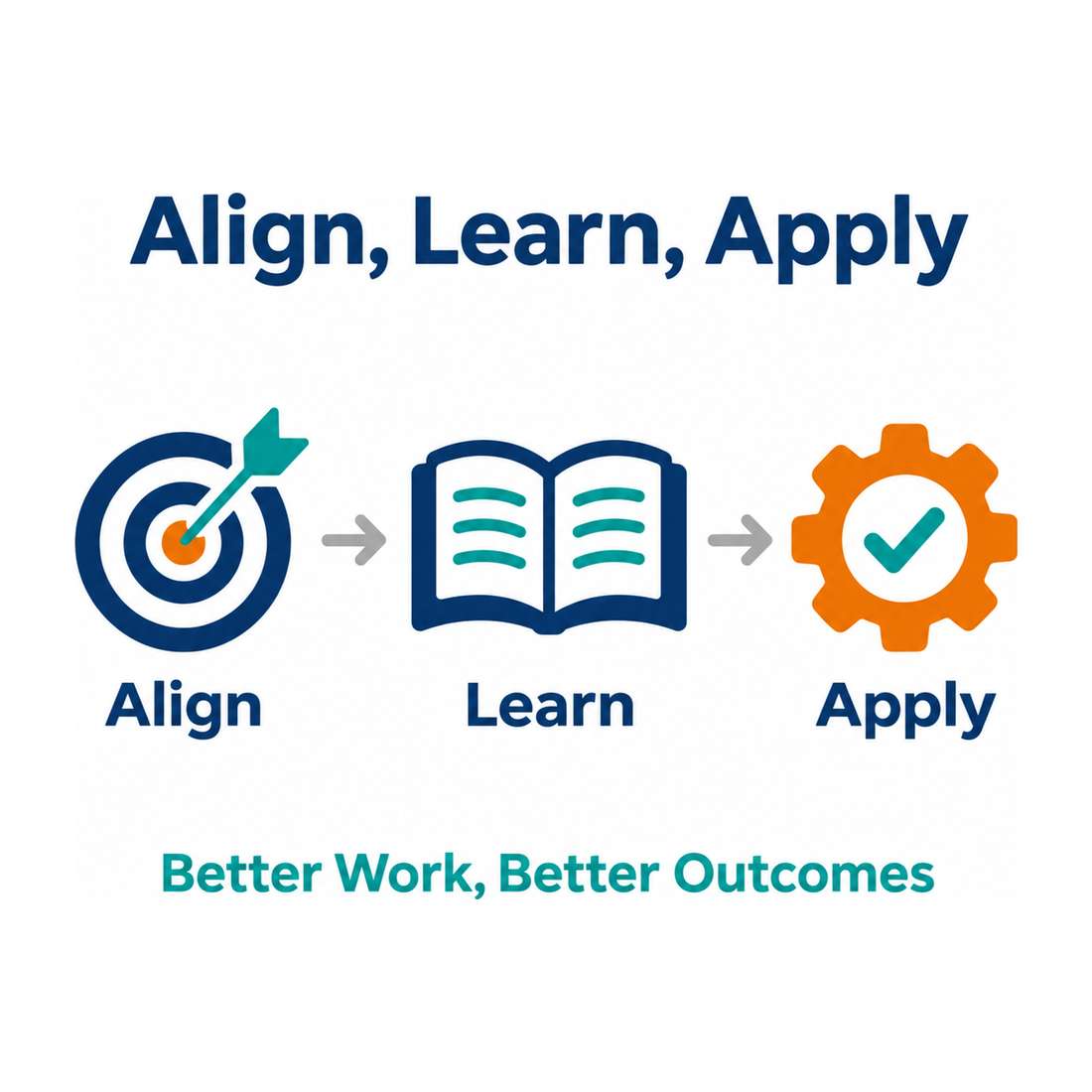
ALIGN: Choose the work worth improving.
Start by identifying the issue you’re trying to solve and the specific capability the business needs to build. Then define the workflows or decisions to improve, the roles involved, current adoption and capability gaps, responsible-use expectations, and what better outcomes look like.
LEARN: Build the skills the work requires.
Build learning programs around employee roles, current skill levels, and the AI tools people use, grounded in job-specific tasks and in judgment, verification, and responsible use. Employees should come away understanding how AI works and how it fits into their work.
APPLY: Turn learning into a repeatable way of working.
Give employees and teams opportunities to use new skills in daily work, including facilitated use-case practice, workflow application, shared team standards, manager reinforcement, reusable prompts or processes, and follow-up coaching, so applying that knowledge builds consistent habits that improve workflows.
From Individual Skill to Shared Practice
An individual can learn a tool on their own. But redesigning the handoffs, decisions, quality checks, and priorities that shape a team’s work takes the whole team, working from shared practices. The goal is for teams and organizations to get better together.2
Time saved isn’t the finish line. Organizations still need to decide where to direct the increased capacity, whether toward higher quality, greater throughput, shorter cycle times, more judgment-intensive work, or another defined priority.
BUSINESS PRIORITY → ALIGN → LEARN → APPLY → BETTER WORK → IMPROVED BUSINESS OUTCOMES
Making Adoption Repeatable and Measurable
AI adoption depends on more than individual skill. Executives define goals. L&D builds employee capability. IT provides tools and guardrails. But managers operate closest to AI implementation.
They see where teams struggle, which applications are valuable, how they should evaluate quality, and where new habits need reinforcement.
Gallup research found that employees who strongly agree their manager supports AI use are 2.1 times more likely to use AI frequently, and 8.8 times more likely to say AI helps them do what they do best every day.3
Managers need confidence and support to help their teams answer questions like: Where should we use AI? Where shouldn’t we? What does good output look like? What requires human review? What should we do with the time we save?
When managers and employees work through those questions together, individual experimentation becomes shared practice.
The Manager Multiplier
The right support determines whether heavy AI use pays off. Gallup Workforce Panel research (30,000+ U.S. employees) linked intensive AI use without a clear, manager-communicated strategy to higher employee burnout. Pair frequent AI use with a clear strategy and high manager trust, and that burnout risk disappears, with engagement rising instead.4
Connect AI Adoption to Business Outcomes
Good measurement goes beyond licenses activated, active users, courses completed, and hours trained. Those measures tell you about initiative delivery, but that’s only half the story. Executives also need to understand whether workflows have improved.
Stopping at delivery metrics has a real cost. Forty percent of employees say they’ve received AI-generated “workslop,” content that looks polished but lacks real substance, in the past month, and each incident takes an average of two hours to fix.5
| Instead of only measuring… | Ask whether you improved… |
| AI usage | Adoption in priority workflows |
| Training completion | Application of new skills |
| Prompts created | Reusable work products or processes |
| Time saved | Capacity redirected to higher-value work |
| Output volume | Quality and consistency |
| Individual speed | End-to-end workflow cycle time |
| Experimentation | Repeatable team practice |
| Activity | Business outcomes |
The right measurements for the work you’re improving matter more than tracking every possible metric. Without a defined outcome, funding, evaluating, and scaling AI capability all get harder.
Capability Is Part of AI Investment
AI implementation isn’t cheap, and something often has to give. Some finance and HR leaders are making an explicit trade: cut training spend to help pay for the software and licenses.
The evidence supports treating AI tools and training as one investment. Software and licenses create access. They don’t tell employees which work to improve, how to use AI responsibly, or what to do with the time they save. Cutting the learning investment to pay for the tools weakens the capability those tools need to produce a return.
The AI license buys access. Training is what turns that access into results. Employee capability belongs inside the AI investment itself, not as a separate line item.
The ROI question: How much value can your AI investment deliver across the organization without employee capability behind it?
Before You Fund Your Next AI Training Initiative, Ask These 6 Questions
AI training initiatives are easy to fund and hard to evaluate. Content libraries, course counts, and completion rates don’t say whether the organization works any differently afterward. The real test is whether training is built to change how work gets done.
Before funding the next AI training initiative, ask these six questions.
1. What business priority or workflow is this training meant to improve?
If the answer begins and ends with “AI literacy,” push for more specificity before funding it.
2. Does the training design account for roles, tools, and skill levels?
An executive, manager, technical team, and frontline employee don’t need the same AI experience.
3. Will employees practice against real work?
Look for hands-on application, relevant scenarios, and opportunities to lean into current workflows.
4. Are managers part of the adoption plan?
Someone needs to reinforce new behaviors, standards, and expectations after the learning experience ends.
5. Does the training build in judgment, verification, and responsible use?
AI fluency should include understanding when to use AI, when not to, and where human review and accountability remain necessary.
6. How will we know whether the work improved?
Define the outcome before the program starts. If attendance or completion is the only measure of success, the business case remains incomplete.
The Bottom Line
The organizations that create the most value from AI connect business priorities, employee capability, manager reinforcement, daily-work application, and meaningful measurement.
Build the Adoption Plan Behind Your AI Investment
Your employees may already be experimenting with AI. Educate 360 partners with organizations ready to turn that momentum into real workflow change.
Together, we can help you turn AI investment into better work:
- ALIGN learning with business priorities and workforce needs.
- LEARN through practical, role-relevant AI experiences.
- APPLY new capability to real workflows and team practices.
Talk with our team about your workforce, AI tools, priority workflows, and adoption goals.
About Educate 360
Educate 360 helps organizations build the capabilities their workforce needs to perform in a changing world. Our AI learning solutions connect business priorities, practical skill building, manager enablement, and real-world application so organizations can move beyond AI experimentation and build more confident, consistent ways of working.
Sources
Every statistic in this post comes from one of the following sources, each chosen for its direct relevance to individual adoption, organizational support, workflow redesign, or team performance.
- Boston Consulting Group, AI at Work: Strategy Matters More Than Tools (4th annual survey), June 3, 2026. Global survey of 11,749 workers across 14 markets.
- Microsoft Research, New Future of Work Report, 2025.
- Gallup, Manager Support Drives Employee AI Adoption, November 8, 2025.
- Christos A. Makridis, The Organizational Transmission of AI, CESifo Working Paper No. 12373, 2026. Gallup Workforce Panel data covering more than 30,000 U.S. employees.
- BetterUp Labs and Stanford Social Media Lab, Workslop, 2025. Survey of 1,150 full-time U.S. desk workers.
A Note on the Data
Percentages are self-reported survey findings. They show patterns and associations, but don’t prove that any one action caused a specific outcome.
Here, “team performance” means improvements in quality, speed, consistency, judgment, reuse, collaboration, and connection to business outcomes.