New Horizons
 Project Management Academy
 Six Sigma Online
 TCM Security
 TRACOM
 Velopi
 Watermark Learning
 Login
Login



Key Takeaways
- Tailored training builds real leaders – One-size-fits-all training fails; programs should match each leadership level’s needs.
- Blended learning works best – Combine formal training, coaching, and hands-on experience to reinforce leadership behaviors.
- Track what matters – Use promotions, feedback, and performance metrics to measure leadership development success.
When a longtime department head suddenly announced her retirement, the leadership team thought they’d be fine. The team under her was strong, the department was steady, and they assumed someone would naturally step up. But when the moment came, no one felt ready. Projects stalled. Morale dropped. And instead of promoting from within, they scrambled to find an outside hire who didn’t fully understand the company’s culture.
This happens more often than people like to admit. Leadership gaps can pop up without warning—from retirements, resignations, or sudden promotions. And when organizations haven’t prepared people to step into those roles, everything from strategy to team performance can suffer.
That’s where a smart learning and development (L&D) program comes in—not just to build skills but to build a pipeline of future-ready leaders at every level. From first-time managers to future executives, the right training can make all the difference when it’s time to pass the torch.
So, how do companies build this kind of pipeline? Let’s break it down.
What Great Leadership Training Covers (That Goes Beyond Managing People)
When people hear “leadership training,” they often think of courses on managing direct reports or giving performance reviews. In many cases, it’s confused with basic manager training, which focuses more on task delegation than long-term leadership growth.
But real leadership goes way beyond management checklists. It’s about navigating uncertainty, guiding teams through change, and making decisions that shape the business—not just the day.
That’s why strong L&D programs go beyond the basics and focus on the essential capabilities that separate great leaders from good managers.
Here are a few of the key areas that make training effective:
- Smart decision-making: Leaders must analyze risks, weigh outcomes, and make tough calls under pressure. Training in frameworks like SWOT analysis or decision trees helps sharpen this ability.
- Strategic thinking: Being a leader isn’t just about “what’s next”—it’s about understanding the big picture. Training helps future leaders connect day-to-day actions with long-term goals.
- Clear communication: Whether giving feedback, running meetings, or presenting to the board, leaders need to speak in ways people understand and trust.
- Emotional intelligence: Empathy and self-awareness can be taught—and they’re essential. Great leaders know how to read the room, manage their reactions, and motivate different types of people.
Building these skills is a great start, but the way you deliver training matters just as much as what you teach. And not everyone needs the same approach. Let’s look at how smart organizations tailor leadership development by career stage to ensure the right people are learning the right things at the right time.
How to Train Leaders at Every Level (From First-Time Managers to Executives)
Think all leaders need the same training? Think again. A new manager trying to figure out how to run one-on-ones doesn’t need the same tools as a VP shaping company strategy. That’s why innovative L&D programs customize learning paths by leadership stage—helping people grow the skills they need now while preparing them for what’s ahead.
According to Brimco, 72% of businesses believe that their leadership pipeline is inadequate.
Here’s how companies break it down:
- Emerging leaders (usually first-time managers) need help with the basics: delegation, time management, coaching, and how to give feedback without sounding like a robot.
- Mid-level leaders manage other managers. They need to work across departments, align resources, and handle more complex decision-making while still being approachable.
- Senior leaders and executives engage in executive development to navigate strategy, culture, and external relationships. They need to shape vision, build alignment across the business, and communicate confidently with the board.
Another key player in leadership development is employees’ own managers. Whether it’s a first-time supervisor or a seasoned department head, direct managers play a huge role in reinforcing learning. When they’re involved—through coaching, feedback, and stretch assignments—employees are more likely to apply what they’ve learned and stay on a growth path.
Some companies also build “high-potential” pools—groups of employees who show leadership promise early on. These individuals receive more targeted development to prepare them for fast-tracked growth.
Structuring training by leadership level gives people the right tools at the right time—but delivery matters just as much. Whether mentoring, hands-on projects, or classroom learning, the format can make or break how well training sticks. Let’s explore the different ways organizations bring leadership development to life.
How to Deliver Leadership Training That Sticks
You can have the best leadership content in the world—but what’s the point if people don’t remember it or use it? Too many companies rely on one-and-done training sessions, only to realize months later that nothing changed.
Effective leadership development isn’t just about what you teach but how you deliver it. The most successful programs combine formal learning with hands-on experience, coaching, and real-world application—creating a mix that helps people build skills that stick.
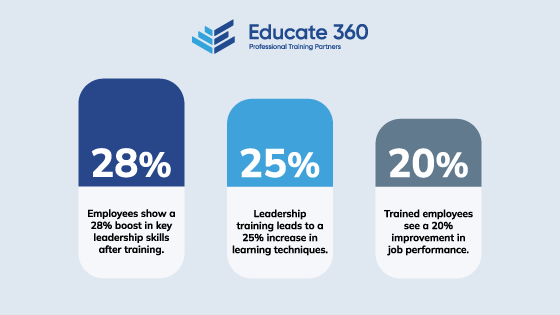
Here are four effective ways organizations deliver leadership training that sticks:
- Formal programs: These can be live or online courses, internal “leadership academies,” or credentialed programs focused on strategic leadership or people management.
- Mentorship and coaching: Pairing future leaders with experienced mentors gives them a safe space to ask questions, get advice, and build confidence.
- Scenario-based training: Simulations—like navigating a crisis or planning a market entry—allow participants to try, fail, course-correct, and succeed, all in a risk-free environment.
- Stretch assignments: Rotating into a new team or managing a short-term project lets employees apply leadership skills in new contexts. It’s one of the fastest ways to build confidence.
- Ongoing reinforcement: Real change happens after the training ends. Reinforce leadership behaviors through regular feedback, reflection exercises, manager check-ins, and integration into performance reviews.
Technology can also help scale leadership development, especially for hybrid or global teams. Learning platforms (LMS), digital coaching tools, and even AI-based simulations allow organizations to personalize training, track progress, and keep development continuous across roles and locations.
A blended approach helps future leaders grow faster and keeps them engaged—but how do you know it’s working? Let’s dig into how to track leadership development progress so you can prove it’s making a real impact.
How to Tell If Your Leadership Development Is Paying Off
You’ve rolled out leadership training—but without measuring outcomes and business impact, it’s impossible to know if it’s truly working. Here are some of the best ways to measure progress—from assessments and feedback to promotions and performance metrics.
- Pre- and post-training assessments to see how skills have improved
- 360-degree feedback to measure changes in behavior from multiple perspectives
- Internal promotion and retention rates to show whether the pipeline is working
- Business metrics like project success rates, employee engagement, and even revenue growth
If the results aren’t strong, it’s a signal that something needs to be tweaked—the content, the format, or the support system. And don’t forget to ask participants for feedback. They’ll tell you what’s helpful and what’s just noise.
With the right data, you can refine your training, prove its value, and scale it across your organization. Now that you know what to measure, let’s turn that insight into action with a checklist to strengthen your leadership pipeline immediately.
Want a Stronger Leadership Pipeline? Start with the Right Training
You’ve seen the importance of leadership training and how it works best when it’s tailored, practical, and measurable. But what does it look like to implement that in your organization? The good news is that you don’t need to overhaul everything at once.
Whether you’re starting fresh or refining a current program, there are clear, simple steps you can take to begin building a strong leadership pipeline today.
Here’s a checklist to help you move forward with focus and purpose.
- Link your leadership training to business goals and succession planning
- Tailor programs to leadership levels and roles
- Blend classroom learning with real-world experience
- Reinforce training with mentorship and coaching
- Track what’s working and adjust as needed
If you’re building your program from scratch, start small, track wins, and share data with leadership early. This is the fastest way to gain more buy-in and budget over time.
Taking these steps today positions your organization for long-term success and signals to employees that leadership growth is intentional, not accidental. Ready to turn the checklist into real progress?
Ready to Train Your Next Generation of Leaders? Here’s How to Start
Leadership gaps don’t wait for your training calendar. Suppose you want your organization to grow, stay resilient, and move forward confidently. In that case, you need a steady bench of capable leaders ready to step up.
At Educate 360, we help organizations design and deliver leadership training programs that work—for first-time managers, seasoned executives, and everyone in between. Whether you’re starting from scratch or scaling what’s already working, our experts are here to help.
Let’s start building a stronger leadership pipeline—together.