New Horizons
 Project Management Academy
 Six Sigma Online
 TCM Security
 TRACOM
 Velopi
 Watermark Learning
 Login
Login



Key Takeaways
- Misaligned Training Wastes Resources: Without alignment, training fails to improve outcomes.
- Start With Business Priorities: Build training around real goals and skill gaps.
- Avoid Common Myths and Missteps: Don’t let assumptions derail strategic impact.
- Measure What Matters: Track results to prove and improve effectiveness.
- Make Alignment Stick: Use a 90-day plan to build momentum and trust.
Misaligned Training Is Costing You More Than You Think
80% of L&D teams fail to achieve strong alignment with business strategy, burning through millions in training budgets without moving performance metrics. Employees may complete training, but if it isn’t aligned with strategy, productivity flatlines, customer scores stagnate, and revenue targets slip further out of reach. The difference between training that works and training that wastes resources isn’t quality, it’s strategic focus.
The Case for Alignment
Here’s what misalignment can look like in practice.
A company sets a goal to boost customer retention. Sales teams need to deepen relationships and resolve issues faster. But instead of training in active listening or product knowledge, they’re sent to a presentation skills course. When training misses real priorities, time is wasted, goals slip further out of reach, and leadership support fades fast.
High-performing organizations don’t treat training as an afterthought; they see it as essential to achieving business goals. They invest in programs that help teams adapt and deliver results as priorities evolve. When alignment is built in from the start, training moves from a line item to a strategic tool.
So why do so many well-designed programs still fall flat? Often, hidden assumptions are to blame.
The Top Myths Holding Back Strategic L&D Alignment
When training isn’t aligned with business goals, it wastes time and resources. Employees disengage, and the effort fails to drive real change. Business leaders expect clear links between training and strategic outcomes. Yet many organizations fall into traps that block alignment from the start.
Breaking this pattern requires identifying and challenging the myths that create misalignment before they can derail your efforts. Organizations that consistently deliver business impact through training have learned to ignore conventional wisdom and design around measurable performance outcomes instead.
Myths that derail alignment:
Myth: High quality training guarantees business results
· Reality: Polished design doesn’t equal impact if the training misses core business challenges.
· Example: A beautifully produced leadership course looks impressive, but if your real issue is customer churn, it won’t move retention numbers.
Myth: Strategic focus kills creativity
- Reality: Clear constraints unlock better ideas.
- Example: When a sales team is tasked with improving discovery calls, they invent sharper tools such as role playing customer scenarios or peer coaching rather than wasting time on generic exercises.
Myth: Happy learners = successful outcomes
- Reality : Satisfaction scores don’t predict performance improvement
- Example: A presentation skills workshop might earn rave reviews, yet sales reps still struggle to close deals because the training didn’t address negotiation skills.
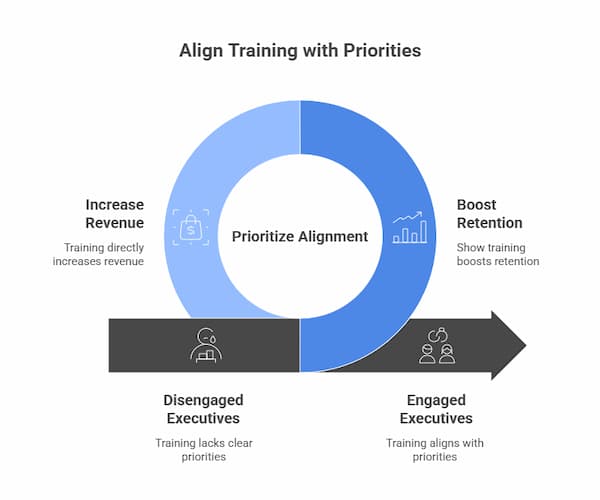
Myth: Executives don’t care about learning
- Reality: Leaders tune out when training doesn’t tie to their priorities, not because they don’t value development.
- Example: Pitch training as a way to boost retention or revenue, and suddenly those “disengaged” execs are asking when the next session is.
Challenging these myths is the first step toward better alignment, but it is not the only one. Many organizations still fall short because they assume good intentions are enough. Without clearly defining what strategic alignment looks like in practice, even well-meaning efforts can miss the mark.
Why Good Intentions Aren’t Enough for L&D Strategy
A strategic connection isn’t just about intention; it’s about clarity. Without a shared understanding of what alignment means, teams risk creating programs that seem strategic but don’t deliver meaningful impact. Defining it from the start helps ensure training delivers what the business truly needs.
That clarity helps avoid common missteps that derail alignment. Here are four to watch for:
- Skipping Soft Skills: EQ, communication, and leadership drive business outcomes.
- Chasing Only KPIs: Alignment requires real change, not just surface, level metrics.
- One-and-Done Thinking: Training must evolve as business goals shift.
- Saying Yes to Everything: Strategic training still needs analysis and focus.
Avoiding these traps builds credibility, keeps training connected to business priorities, and creates momentum. With misconceptions out of the way, alignment becomes easier to sustain, and measurable outcomes become far more achievable.
From Strategy to Skills
Start With Business Priorities, Not Training Ideas
Creating a strategic connection starts with understanding what the business needs most. Before building a training plan, define the company’s goals and the obstacles in the way. This means identifying skill gaps and tailoring programs to boost performance.
Steps to clarify business priorities:
- Identify short- and long-term goals
- Use terms like revenue, retention, and productivity
- Link problems to skill gaps
- Understand the pressures behind each goal
- Involve leaders who track performance
Questions to ask stakeholders:
- What are your top priorities for the next 12 to 18 months?
- What skills would help your team reach those goals?
- How do you define and measure success?
- What would success look like if one major challenge were solved?
If leadership access is limited, connect with department heads or champions. Focus conversations on performance outcomes, not training formats. Partnering across departments reveals what matters most and keeps training relevant and current.
How to Translate Business Strategy into Training Objectives
Once business priorities are clear, they should become specific learning objectives. Identify the key skills employees need to support those goals and pinpoint the most important gaps. Targeted training then closes those gaps and drives meaningful results.
Translation framework:
- Step 1: Break Down Goals
o Example: “Increase customer retention” maps to relationship building, product knowledge, and communication.
- Step 2: Identify Skill Gaps
o Example: Use data and feedback to prioritize high-impact skill gaps.
- Step 3: Define Learning Objectives
o Example: “Train reps on empathy” becomes “Reps use active listening and resolve 75% of issues on first call.”
Linking business goals to learning objectives ties training directly to performance. Measurable targets show how skills impact outcomes. This clarity helps employees understand the value and makes progress easier to track.
Defining objectives is only half the battle; proving they work is what earns leadership trust.
Designing Training with Measurable Business Impact
Training only works if you can show its results. To prove it is helping and to keep improving it, you need to track both early signs and results that connect to business goals. These strategies help make sure training stays useful, trusted, and tied to real outcomes.
Measure training from multiple angles to show its full impact:
- Early Indicators: Attendance, learning, confidence, manager feedback
- Performance Results: Key metrics, customer outcomes
- On, the, Job Application: Skills used in real work with visible results
- Before, and, After Comparison: Measure now, compare later
A structured approach to measurement makes training part of how organizations drive growth. By aligning measurement with strategy, strong programs link metrics to strategy and communicate results in business terms, which is key to avoiding common alignment pitfalls.
Sustaining Alignment
The Alignment Mistakes That Sabotage Training Impact
Wanting to align training is a good start, but not enough. Simple mistakes can cause setbacks and erode trust in your program. With the right plan and tools, you can correct them quickly and deliver results.
Common Alignment Mistakes:
- Assuming alignment: Don’t assume; clearly link training to business goals and metrics.
- Designing in isolation: Bring in voices from operations, not just L&D or HR.
- Overpromising or mismeasuring: Set realistic goals with clear, performance, based metrics.
- Bad timing: Avoid launching programs during peak workloads or significant change.
- Lacking buy-in: Build commitment through cross-team partnerships and small pilots.
These challenges may slow progress, but they don’t have to derail it. Well planned training anticipates resistance and stays focused on outcomes, helping organizations navigate complexity with confidence. The key is having a plan that turns insight into action.
A 90-Day Plan to Start Aligning Now
Once strategy and alignment mistakes are addressed, it’s time to act. A 90-day plan enables teams to move quickly without overextending themselves. It’s long enough to show real progress, but short enough to maintain momentum and focus. Early wins build credibility, secure leadership support, and set the stage for lasting alignment.
To help your teams move forward confidently, here’s a simple 30, 60, 90, day action plan:
Days 1–30: Foundation Setting
- Conduct stakeholder interviews
- Map current goals and pain points
- Review existing programs for misalignment
- Identify quick, win opportunities
Days 31–60: Strategic Design
- Co-design pilots tied to business KPIs
- Set baselines and success metrics
- Partner cross-functionally to build traction
- Create messaging for business value
Days 61–90: Launch and Iterate
- Launch pilot and collect feedback
- Monitor early success indicators
- Adjust as needed before scaling
- Prepare and share early impact reports with leadership.
A strong 90-day start builds momentum. To keep it, L&D must clearly show how training drives business results. That’s what turns quick wins into lasting value.
How to Show L&D’s Strategic Value to the Business
Even strategically aligned training fails without clear communication about its business impact. Leaders need to see concrete ROI. Employees need to understand how new skills solve their daily challenges. Managers need practical tools that integrate learning into existing workflows. Without targeted messaging for each audience, even successful programs struggle to maintain support and momentum.
Communication strategies by audience:
For Executives: Present training metrics alongside business KPIs in quarterly reviews. Show direct connections: “Customer service training reduced complaint resolution time by 30%, improving satisfaction scores and saving $200K annually in escalation costs.”
For Leaders: Provide implementation toolkits with conversation guides, check, in templates, and reinforcement activities. Make it easy for them to extend learning beyond the classroom without additional prep work.
For Learners: Connect training to immediate job performance and career growth. Instead of generic course descriptions, explain: “This module helps you handle difficult customer conversations more confidently, reducing stress and improving your performance ratings.”
Strategic communication transforms training from an expense that requires justification into a competitive advantage that generates requests for expansion.
How Educate 360 Helps You Align Training to Strategy
When training aligns with business strategy, it stops being an extra task and becomes a competitive edge. It drives results, supports long, term growth, and helps organizations move faster in the right direction. That’s the power of alignment done right.
Educate 360 helps organizations achieve that alignment. Whether you need to train frontline teams, develop emerging leaders, or drive enterprise-wide transformation, our experts deliver programs that connect directly to your top priorities.
With Educate 360, you gain a strategic partner that understands how leadership, process, and technology work together to drive results. We help you align training with business goals, accelerate progress, and prove its impact.