New Horizons
 Project Management Academy
 Six Sigma Online
 TCM Security
 TRACOM
 Velopi
 Watermark Learning
 Login
Login



Key Takeaways
- Process connects everything: It aligns leadership and technology so work runs smoothly.
- Lack of process leads to chaos: Teams improvise, duplicate effort, and lose momentum.
- Alignment boosts performance: When process, leadership, and technology work together, results follow.
- Training builds adaptability: Process training equips teams to improve and collaborate.
- Strong processes drive growth: They boost efficiency and support long-term success.
A mid-sized company had everything going for it—smart leadership that could rally a room and cutting-edge technology that could outpace competitors. The problem? Projects kept falling apart halfway through. Teams were enthusiastic, but they didn’t know who was doing what. Tools overlapped. Meetings went in circles. Deadlines slipped because no one had mapped the path from start to finish.
They weren’t missing vision or tools. They were missing structure.
That’s the risk when one of the three pillars of business—leadership, process, and technology—gets left behind. While leadership sets direction and technology enables action, process connects the two. Without it, even the best ideas can stall.
We’ll take a closer look at the role of the process pillar—what breaks down when it’s missing, what works when it’s strong, and how organizations can train their teams (especially Business Analysts) to spot gaps and build systems that help work run smoothly.
What Makes Leadership and Technology Work? Process.
A thriving business functions a lot like a well-run sports team. You need a coach who sets the strategy (leadership), equipment that works (technology), and—this is key—plays that everyone understands and can execute (process). Without that playbook, even star players get lost.
Every pillar—leadership, process, and tech—has a job to do:
- Leadership sets the direction and motivates people—but without structure, even great ideas can get lost in the shuffle.
- Technology enables the work through automation and data—but even the smartest software can’t deliver results if no one agrees on how and when to use it.
- Process makes sure execution stays on track and can scale—it’s the glue that holds strategy and tools together day to day.
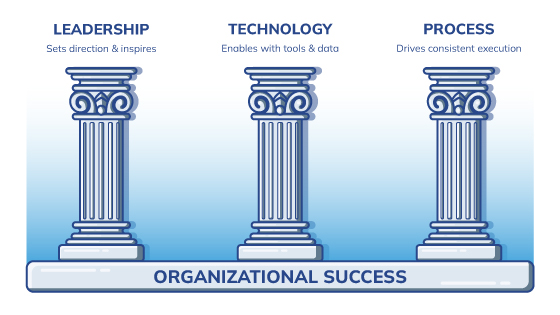
The warning signs aren’t always obvious when one pillar—especially process—is missing. Everything may seem fine, but teams often start improvising without realizing it. And without shared workflows or clear roles, even strong teams lose their footing. Missteps add up, and the technology built to help them ends up underused or misunderstood.
So, what happens when leadership and technology are in place—but process is still missing?
Why Process Gaps Derail Even the Best Teams
Imagine your organization implemented a new CRM system to improve sales and customer support. You’ve got leadership onboard and powerful software. But without clear steps—who enters data, when updates happen, how leads are handed off—you’ve handed your team a powerful tool… with no instructions.
This kind of scenario is more common than you think. It’s not about having the wrong people or bad intentions. It’s simply the result of missing structure.
”If you define the problem correctly, you almost have the solution.” -Steve Jobs
Here are the ripple effects that unfold when processes don’t support leadership and technology:
- No clear roles or responsibilities: Employees often duplicate work or skip steps because expectations are vague.
- Inconsistent results: Each team or manager improvises their approach, leading to uneven customer experiences and variable quality.
- Slower decision-making: Without standard operating procedures, every decision becomes a debate or requires escalation.
- Frustrated teams: Employees spend more time solving avoidable problems than doing meaningful work. And eventually, they burn out.
Over time, a lack of structure doesn’t just slow things down—it reshapes the culture. Teams stop looking ahead and start bracing for what might go wrong. Instead of solving problems, they spend energy reacting to them. Eventually, the gap between effort and results becomes too big to ignore.
But something very different happens when process is no longer the missing link—when it works harmoniously with leadership and technology. Let’s see what’s possible when all three pillars are fully aligned.
What It Looks Like When Process, Leadership, and Tech Work Together
When leadership, process, and technology are aligned, it’s like an engine running at full efficiency. You can see and feel the difference—faster execution, clearer communication, and better morale. People aren’t just working hard; they’re working smart.
Back to that CRM example: this time, the company launches it with a cross-functional plan—mapping the customer journey, assigning ownership, and automating repetitive tasks. Sales, marketing, and support follow the same playbook. Weekly reviews help teams adjust in real-time. The result? Faster lead conversions, better customer satisfaction, and fewer missed handoffs or opportunities.
Or consider this real-world scenario: A regional logistics firm struggled with delivery bottlenecks due to siloed communications and unclear escalation paths. After adopting Lean Six Sigma principles, they mapped their delivery process, identified delays tied to poor handoffs, and retrained dispatch teams on standardized workflows. Within three months, on-time delivery rates rose by 40%, and customer churn dropped significantly.
When process gets the attention it deserves:
- Teams move with confidence, not confusion.
- Tech investments deliver on their promise.
- Leaders spend less time dealing with urgent issues and more time focusing on long-term progress.
- Employees feel empowered and productive, not overwhelmed and stuck.
When leadership, process, and technology reinforce one another, the organization doesn’t just operate more efficiently; it becomes more adaptable, resilient, and aligned around shared goals. But this kind of harmony doesn’t happen by chance. It results from intentional effort, cross-functional collaboration, and, most importantly, skill-building.
So, how do you build the capability to empower teams to design smart processes, lead effective changes, and use technology to its full potential? That’s where process training comes in.
How Process Training Helps Teams Do More—and Do It Better
Getting your process pillar in shape relies on building internal capability—training your teams to spot inefficiencies, optimize workflows, and continuously improve. This is where business process training comes in.
”If you have always done it that way, it’s probably wrong.” – Charles Kettering
Effective training helps teams not just follow processes but improve and align them with larger goals.
Here are the core process skills every organization should prioritize:
- Project Management: Teams must be able to plan, execute, and track progress using methods that scale. While project management handles short-term efforts, it often overlaps with process improvement when changes are long-term.
- Process Improvement & Optimization: Training in Lean, Six Sigma, or Agile methodologies helps employees remove waste, speed up delivery, and focus on value-added activities.
- Risk Management & Compliance: Organizations must assess new risks as workflows evolve and ensure they meet industry standards or regulatory requirements.
Process training doesn’t just streamline workflows—it encourages better collaboration between departments that often operate in silos. When teams share a common process language, it’s easier to align efforts, reduce duplication, and make smarter decisions together.
Even with the right tools and training, teams can run into barriers—unclear priorities, siloed thinking, or resistance to change. That’s why strong process training also emphasizes communication, collaboration, and aligning improvements to broader business goals.
This is where Business Analysts (BAs) shine. They bridge the gap between strategy and execution—gathering stakeholder input, analyzing data, and recommending process changes that improve outcomes. Whether defining system requirements or mapping workflows, BAs build structures where they are missing and improve them where they exist.
Their ability to ask the right questions, surface hidden inefficiencies, and turn goals into actionable steps makes them invaluable to any process improvement initiative.
And what’s the return on all this?
- Lean and Six Sigma methodologies can reduce process costs by 25–50%.
- IBM research shows that organizations focusing on business process improvement can see productivity gains of up to 30% within a year.
These gains aren’t just theoretical but measurable, repeatable, and transformational. With the right training, teams don’t just fix problems—they prevent them, improve cross-team collaboration, and help the organization scale. Empowered BAs, project managers, and team leaders become catalysts for change at every level.
Investing in process training is more than a quick fix—it’s a strategic move that strengthens your entire business framework. When process joins leadership and technology at the table, you’re no longer just reacting to challenges—you’re prepared to overcome them.
”An organization’s ability to learn, and translate that learning into action rapidly, is the ultimate competitive advantage.” – Jack Welch
And none of it sticks without change management—process training also prepares teams to lead and adapt to change with clarity and confidence.
Of course, lasting change requires more than skills alone. When executive leaders champion process training, it signals that structure matters—and that everyone has a role in improving how work gets done.
But process alone isn’t enough. All three pillars must be in place to move forward with clarity and confidence. Let’s bring it all together.
Strengthen Your Process Pillar to Move Your Business Forward
Most teams work hard, but without structure, that effort doesn’t lead to real progress.
That’s why the process pillar matters. It shapes strategy, connects leadership with action, and makes technology deliver real results.
At Educate 360, we help organizations build that foundation. Our business process training programs go beyond theory to develop real-world skills. From project managers to Business Analysts, we equip teams to improve and scale the processes that keep everything moving.
Whether leading a department or building better systems, Educate 360 helps you turn process skills into business wins. Let’s build the foundation that allows your team to grow, adapt, and thrive—even when the next challenge hits.