New Horizons
 Project Management Academy
 Six Sigma Online
 TCM Security
 TRACOM
 Velopi
 Watermark Learning
 Login
Login



Key Takeaways
- Leadership gaps are costly: Vacancies slow performance and reduce team confidence.
- Potential isn’t readiness: High performers may have ability but lack leadership experience.
- Personalized growth drives readiness: IDPs connect learning to future roles and clear milestones.
- Culture sustains development: Leadership pipelines thrive when learning becomes a shared value.
- Readiness must be deliberate: Integrating L&D and succession ensures business continuity.
Leadership continuity is the foundation of long-term success. Yet too often, organizations focus on the present and forget to prepare for the future. Succession planning works best when it’s more than a list of names; it’s a plan for learning, growth, and readiness.
Developing future leaders is not just HR’s job; it’s a shared responsibility. Everyone has a role in building readiness into daily operations:
- Executives ensure leadership development is a strategic priority.
- Managers identify leadership potential and create growth opportunities.
- Learning Partners design programs that build capabilities and confidence.
When SentinelWave’s Director of Operations left unexpectedly, the company discovered how fragile its succession planning truly was. The disruption exposed how quickly performance and confidence can falter when leadership readiness is not built into daily operations.
The experience led HR and business leaders to rethink their entire approach to developing future leaders. It began with one painful vacancy and evolved into a long-term culture of readiness.
Research confirms the pattern. Executive replacements can take up to six months to complete, with another year before full productivity returns. Meanwhile, institutional knowledge is lost, engagement drops, and missed opportunities pile up.
When learning and development are woven into succession planning, disruption gives way to continuity. Preparing leaders in advance strengthens confidence and stability. Read on to see how organizations can build lasting leadership readiness at every level.
When No One’s Ready to Step Up
Leadership transitions are inevitable, but unprepared teams make them painful. When vacancies appear without successors in place, operations slow, projects stall, and employees lose direction.
After the surprise departure of their Director of Operations and the long, costly search to fill the role, SentinelWave’s senior leaders and HR team met to understand what went wrong. Around the conference table, the frustration was clear. Projects had slowed, workloads were uneven, and the leadership gap had strained morale across departments.
One executive admitted the obvious: they had no true succession plan, just a list of names. HR agreed, adding that no one had been formally developed or prepared to step into critical roles.
To avoid a repeat, the group aligned on three actions they would take moving forward:
- Identify critical roles early to ensure continuity in key positions.
- Assess internal talent regularly to spot emerging leaders.
- Build readiness through ongoing development so transitions happen smoothly.
Succession planning must start long before a role opens. It’s about building confidence, not just capability. Organizations that invest early keep performance steady through change and protect the trust of both employees and clients.
Succession planning isn’t about predicting turnover; it’s about building a leadership pipeline that continually grows. When learning keeps pace with strategy, leaders can rise naturally into roles rather than being thrust into them under pressure. But recognizing future leaders isn’t just about finding them; it’s about knowing who’s truly ready to lead.
Why High Potential Doesn’t Always Mean Leadership Readiness
Every organization has employees with promise. But potential alone doesn’t make someone leadership-ready. Readiness requires applied experience, decision-making ability, and perspective, the traits that turn skill into influence.
As the conversation shifted, one department head acknowledged a painful truth: several of their most recent promotions hadn’t gone well. High-performing specialists had been elevated to leadership roles too quickly, and many struggled to manage people effectively.
HR pointed out that this pattern wasn’t unique to one department; it was systemic. The company had been confusing technical excellence with leadership potential. They promoted the best individual contributors, assuming success would translate into management readiness.
The group agreed that this assumption had to change. Together, they began sketching out a clearer way to define leadership readiness, one that emphasized behavior, decision-making, and emotional intelligence, not just performance metrics.
Defining the difference between Potential and Readiness:
- High-potential employees show the aptitude and motivation to grow.
- Ready-now leaders already demonstrate the judgment to lead today.
Someone suggested developing a readiness matrix as a simple way to map current talent against future role requirements. Heads nodded around the table. The tone shifted from frustration to focus as they began to see how structure could bring clarity.
Clear definitions transform talent conversations from guesswork to strategy. Once leaders know who has the potential to grow and who is ready to lead, they can guide their development in ways that create visible, lasting progress.
How Personalized Development Turns Potential into Readiness
Development becomes powerful when it’s personal. Individual Development Plans (IDPs) turn vague career goals into specific, measurable actions tied to future leadership needs. They make readiness both visible and achievable.
With the whiteboard now full of notes, HR steered the discussion toward how to prepare employees for future leadership opportunities once they’d been identified. They admitted that development across the company was inconsistent. Some teams offered mentoring, others nothing at all.
HR proposed introducing Individual Development Plans (IDPs) for anyone identified as high-potential. These plans could outline the skills, experiences, and milestones employees needed to reach readiness.
Strong IDPs include:
- Clear competencies aligned to future responsibilities.
- Stretch assignments that challenge employees in real-world contexts.
- Ongoing coaching to support reflection and growth.
- Defined milestones to track measurable progress.
Leaders agreed that standardizing IDPs would create consistency and transparency. They would treat IDPs as living documents, updated regularly through manager check-ins and career discussions. However, someone pointed out that training programs have come and gone before and that enthusiasm faded in six months.
Many organizations face the same dilemma. The key to successful training initiatives is to keep development aligned with business strategy.
Build Leadership Strength That Lasts
Leadership pipelines grow stronger when learning happens continuously. Short-term training builds skills; sustained development builds capability. Effective L&D frameworks prepare people to lead across levels and functions.
The group reflected on past development efforts and realized they’d been too event-driven, such as one-off workshops that taught skills but didn’t build capability. They agreed that this time had to be different.
HR proposed building a tiered development framework that would address every level of leadership with structured learning, mentoring, and real-world experience.
A scalable framework keeps development practical:
- Emerging Leaders: Build self-awareness and communication skills.
- Mid-Level Leaders: Focus on decision-making and team leadership.
- Executives: Strengthen strategy, influence, and systems thinking.
They discussed using the 70-20-10 model to ensure most learning came from experience and coaching. Someone suggested integrating technology so managers could track progress in real time. The idea of a readiness dashboard drew immediate interest.
But even the best frameworks only go so far without a culture that reinforces them. Lasting leadership strength requires more than programs; it requires shared belief and visible commitment from every level.
Build a Culture That Values Development
Skills training creates leaders; culture sustains them. When learning becomes part of the organizational DNA, employees view growth as expected, not optional. A strong culture keeps people engaged and ensures leadership pipelines stay active.
In reviewing its culture, SentinelWave’s CEO admitted that leaders at all levels, including senior executives, hadn’t modeled employee development as an organizational priority.
HR suggested tying development goals directly to performance reviews and publicly recognizing managers who mentor others. The group agreed that visible accountability would send a powerful message: leadership growth isn’t optional, it’s part of the job.
A strong development culture boosts retention, engagement, and recruitment. People are drawn to organizations that value growth and talent development, making it a powerful driver of attraction and retention. To ensure that a development culture is maintained, organizations need a roadmap for success.
A Practical Roadmap to Succession Success
Strong ideas only matter when they’re applied consistently. A practical roadmap ensures that succession planning and learning stay aligned, measured, and repeatable across the organization.
Before wrapping up, the team reviewed everything they’d discussed. Someone summarized what they’d learned on the whiteboard and noted that to make this structure real, they needed a simple, repeatable process to track quarterly progress within each department.
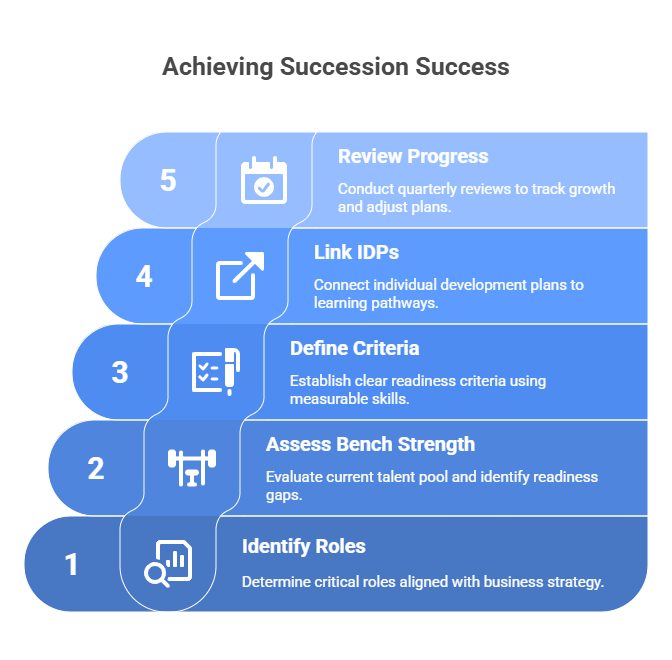
A Five-Step Roadmap for Success:
- Identify critical roles tied to business strategy.
- Assess current bench strength and identify readiness gaps.
- Define clear readiness criteria using measurable skills and behaviors.
- Link IDPs to learning pathways and role requirements.
- Review progress quarterly to track growth and realign plans.
The group agreed to finalize the roadmap within the month and revisit it every quarter. The meeting ended not with a perfect plan, but with shared ownership and a commitment to ensure that the next leadership change would tell a very different story.
Structure and accountability keep succession planning alive. Regular reviews turn growth into a steady rhythm rather than a reaction to turnover. Still, some leaders hesitate to invest, fearing trained employees might take their new skills elsewhere.
Address the “What If They Leave?” Concern
Many leaders hesitate to invest deeply in development, fearing that employees will take their new skills elsewhere. In reality, not developing people is the bigger risk. Employees stay longer in organizations that invest in their growth.
As the discussion wrapped up, the group turned to one final hesitation based on whether investing in development might encourage employees to take their new skills elsewhere. HR emphasized that the greater risk was failing to develop people at all, since lack of growth often drives turnover.
The team agreed to track engagement and retention among participants in leadership programs to confirm that development builds loyalty, not attrition. They concluded that preparing people for future roles strengthens the organization either way, through stronger leaders who stay or a reputation that attracts new talent.
The benefits work both ways:
- If employees stay, your leadership pipeline grows stronger.
- If they leave, your reputation for developing leaders attracts new talent.
Investing in development always pays off. Whether people stay or move on, the organization gains reputation, resilience, and a steady flow of capable talent ready to lead with confidence.
Don’t Wait for a Vacancy to Start Preparing
Leadership continuity is built through deliberate learning and planning. When L&D and succession align, organizations turn change into opportunity.
Eighteen months after adopting its new approach, SentinelWave filled roles faster, promoted more from within, and saw higher engagement. Managers who once hesitated to delegate now viewed developing successors as a core responsibility.
What started as a response to one vacancy grew into a culture of readiness that fueled innovation, confidence, and consistent performance. Succession planning works best when learning is proactive and measurable, keeping businesses resilient and future-ready.
Educate 360 partners with organizations to turn succession planning into a competitive advantage. Through leadership, project management, and professional-skills development training, we equip teams to grow from within, build bench strength, and sustain performance through every transition. Preparing people before they’re needed isn’t just smart planning, it’s how resilient organizations lead the future.