New Horizons
 Project Management Academy
 Six Sigma Online
 TCM Security
 TRACOM
 Velopi
 Watermark Learning
 Login
Login


Key Takeaways
- Focus on outcomes: Completion rates don’t prove business value.
- Build layered metrics: Connect participation, behavior change, and results.
- Speak the language of leadership: Demonstrate how training supports business goals.
- Avoid vanity metrics: Measure what drives impact, not just engagement.
- Use stories and timing: Turn data into influence with smart delivery.
Introduction
L&D teams are under pressure to prove their value, but most still report metrics that business leaders don’t trust or don’t care about. This blog demonstrates how to develop and present L&D metrics that resonate across leadership levels, secure buy-in, and drive stronger decisions.
The Basics
Why Completion Rates Don’t Win Leadership Support
Not all metrics are equal, and not every number tells a meaningful story. L&D teams often lead with participation data, but that’s rarely enough to influence leadership decisions. What matters most is the connection between what was learned and what changed in the business.
Mini-Case Example
An L&D team reports that 95% of employees have completed new training. The COO asks, “Did it improve customer satisfaction or reduce errors?” No one knows. Participation was high, but the impact was unclear. Without clear data on how teams improved, leadership was unable to justify future investment.
To move beyond surface-level data, L&D requires a structure that demonstrates how training activities lead to tangible, real-world results. That begins with understanding how to build layered metrics that reveal the whole picture.
Mini-Success Example
After adopting a layered metrics approach, a regional operations team tracked manager feedback and post-training surveys. Within 90 days, onboarding time dropped by 22%. Not only did the business fund a second training rollout, but they also asked L&D to present the results at the next leadership offsite.
3 Layers of L&D Metrics That Prove Business Value
Not all metrics carry the same weight. Some tell you what happened. Others show what has changed. The most valuable ones explain why it matters to the business.
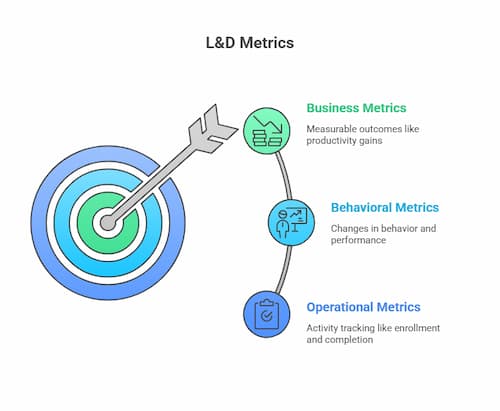
A strong measurement strategy includes three connected layers:
- Operational Metrics: Track activity such as enrollment, completion, and attendance. These are useful for monitoring engagement but don’t reveal outcomes. A 90% completion rate means little if the training doesn’t lead to performance improvement.
- Behavioral Metrics: Focus on changes in behavior and performance. Did employees apply what they learned? Can managers see a difference in how work gets done? Sources include post-training manager feedback, 360 reviews, and pulse surveys.
- Business Metrics: Tie learning to measurable outcomes like productivity gains, cost savings, improved quality, lower turnover, or faster onboarding. They offer the clearest sign of impact but often take longer to track and require collaboration across teams.
These layers build on each other. Operational metrics show whether people showed up. Behavioral metrics show whether anything changed. Business metrics indicate whether it was worthwhile. When linked together, they provide a chain of evidence that tells a complete story. Without that connection, metrics stay siloed, and so does L&D.
Getting Leadership Buy-In
What Business Leaders Expect From L&D Reporting
Business leaders don’t care about training logistics. They care about business priorities. And each leader sees value through a different lens. L&D leaders must understand these perspectives to stay relevant.
Here’s what matters to different stakeholders:
- CEOs and COOs seek productivity improvements, cost reductions, and risk mitigation.
- CFOs care about return on investment, cost avoidance, and alignment with broader financial goals.
- CHROs and HR leaders focus on retention, internal mobility, and workforce readiness.
- Business unit leaders expect training to help their teams achieve specific goals, such as rolling out new tools, launching products, or enhancing customer service.
- CLOs and L&D leaders must bridge the gap between operational tracking and strategic impact.
When leadership defines success, it’s easier for L&D to focus on what matters and align efforts across departments. That starts with a practical, collaborative setup, setting baselines, aligning goals, and using familiar systems like HR dashboards or LMS tools. Built into daily workflows, reporting becomes easier and more effective.
How to Collect L&D Metrics Without Overloading the Business
Once you know what to measure, the next challenge is how to collect the data without turning every program into an administrative burden. Too often, L&D teams attempt to track everything, only to exhaust their managers, drown in spreadsheets, or worse, produce inconsistent data that business leaders don’t trust.
A smarter approach begins by embedding measurements into the systems and processes that teams already use.
Use the systems you already have
- Most LMS, HRIS, and BI tools come with built-in analytics, surveys, or integrations. You don’t have to be a data expert, just start with what you already have. Ask the right questions and work with the teams who can help surface the insights.
Align with partners in HR, IT, and business units
- You don’t have to collect data alone. Much of it lives in systems managed by other teams. HR can provide turnover or engagement scores, while IT can share adoption or usage data. Collaborate with business units to define success and plan measurement together.
Automate when possible, but not blindly
- Automation can help you stay consistent, but only if your data is clean. Start small—track feedback automatically or send a follow-up survey 30 days after training. See how it works before scaling up.
Use light-touch behavioral tools
- You don’t always need long surveys. Short pulse surveys, manager feedback forms, or “check-in” reflections can help capture real behavior change. Consider using simple 3–5 question formats tied to specific behaviors that training was meant to influence.
Design your cadence intentionally
- Try the 30-60-90-day rule. Start by measuring immediate reactions after training. Follow up 30 days later with managers or team leaders. At 60 or 90 days, look for performance outcomes or behavior changes. Spacing out data collection gives you better insight without overwhelming people.
Don’t confuse quantity with insight
- You don’t need to collect everything. Focus on what matters, from the people and systems best positioned to show whether the learning made a difference.
The best reporting systems don’t add work; they add clarity. When you keep measurement focused, collaborative, and well-timed, you’ll collect stronger data and face fewer objections along the way.
L&D Reporting Mistakes That Undermine Credibility
Even with the best intentions, it’s easy to fall into traps that weaken your message. Some metrics mislead, while others confuse. And a few do more harm than good.
Here are some common missteps to avoid:
- Highlighting vanity metrics like “80% said the session was helpful.” These don’t prove anything about long-term value.
- Skipping the connection between training and performance. You can’t assume that learning equals doing.
- Using inconsistent methods across programs renders comparisons meaningless and makes it difficult to track trends.
- Overloading reports with raw data instead of offering clear insights. Data alone doesn’t persuade; context does.
- Over-promising what training alone can achieve. Most business results depend on many variables, and training is just one part of the picture.
Attribution challenges are also common. When business outcomes shift, how much of that change came from training versus process changes, tech rollouts, or leadership adjustments? Being honest about this helps you stay credible. It also gives you room to build stronger cases over time.
Measurement is not a finish line; it’s a feedback system that sharpens both strategy and execution. The fix isn’t perfection; it’s consistency and transparency. Make small gains visible, acknowledge limitations, and stay focused on trends, not just snapshots. That’s how you move from reactive reporting to real influence.
From Data to Business Impact
How to Turn L&D Data into Leadership-Ready Stories
Business leaders don’t remember spreadsheets. They remember stories. That’s why good reporting needs more than accurate data. It needs context, clarity, and meaning.
Here’s how to turn metrics into memorable narratives:
- Pair each key metric with a short story or explanation. For example, don’t just say onboarding time dropped, explain how that led to faster project starts.
- Add testimonials from managers who saw results firsthand. These carry weight when leaders are evaluating program budgets.
- Highlight one “before and after” example each quarter. This comparison keeps the focus on outcomes over activity.
- Avoid training jargon and use business language. Say “sales cycle shortened” instead of “knowledge transfer improved.”
- Present trends visually with graphs, dashboards, and infographics. Business leaders don’t have time to dig—they need fast, scannable insights.
Time your reports to align with quarterly business reviews or budget planning cycles because this is when business leaders are most open to allocating resources and attention.
If your story is solid, you don’t need dozens of metrics. One strong result that aligns with a business priority will always win more attention than a spreadsheet filled with attendance rates. When the data speaks their language, leaders stop asking if L&D matters. They start asking what’s next.
Make Every Metric Count
Training should do more than check a box. When measured correctly, it becomes a clear driver of business performance. It helps teams improve their workflow, supports faster decision-making, and delivers measurable value throughout the organization.
That’s what Educate 360 helps you unlock. We bring together leadership, technology, project management, cybersecurity, business analysis, and process improvement training under one umbrella. You get expert delivery in the right format, seamless coordination across disciplines, and metrics that speak the language of business.
Our training doesn’t just end in a report. It creates clarity, builds capability, and helps your teams deliver stronger outcomes where it matters most. From setting baselines to building insights that resonate with business leaders, we help you connect learning to impact, without adding complexity.
With Educate 360, you get more than completed courses. You get a partner who understands how to turn training into a strategic advantage.